Introduction: The Question Every Beginner Asks
"Where can I learn forex trading in Kenya?" It's the question I get asked more than any other. After 15 years of running Kenya's leading forex academy and training over 5,000 students, I've helped thousands of people answer this exact question. And I'm going to help you answer it too.
But here's what most people don't realize: the answer isn't as simple as picking a location on a map. The best place to learn forex trading in Kenya depends on your learning style, budget, schedule, and goals. What works for a university student in Nairobi might be completely wrong for a working professional in Mombasa or a diaspora Kenyan in London.

In this comprehensive guide, I'm going to walk you through every viable option for learning forex trading in Kenya - from physical academies in Nairobi to online forex trading courses you can take from anywhere in the world. I'll share the pros and cons of each approach, real cost comparisons, success rates based on our data from 5,000+ students, and my honest recommendation after 15 years in this industry.
By the end of this article, you'll know exactly where to learn forex trading in Kenya based on your specific situation. No guesswork, no wasted money, no wrong decisions. Let's dive in.
Why Location Matters (But Less Than You Think)
Before we get into specific locations, let's address the elephant in the room: Does location actually matter when learning forex trading?
The short answer: Yes and no. Let me explain.
Why Location Matters
Location matters in three key ways:
- Access to quality instructors: The best forex trading mentors tend to cluster in major financial centers. In Kenya, that's Nairobi. If you want face-to-face mentorship from top traders, you'll likely need to be in or near Nairobi.
- Networking opportunities: Being physically present in a trading hub means you can attend live events, meet other traders, and build relationships that accelerate your learning.
- Timezone alignment: If you're learning to trade the London session (which opens at 10:00 AM EAT), being in Kenya's timezone is ideal. Diaspora traders in different timezones need to adjust their schedules.
Why Location Matters Less Than You Think
Here's the thing: the quality of education matters far more than the location. A mediocre academy in Nairobi won't teach you as much as an excellent online course. A great mentor in Mombasa is better than a terrible one in Nairobi.
The Research
A 2024 study by the Kenya Institute for Public Policy Research (KIPPRA) analyzed 1,200 forex traders across Kenya and found that the quality of education (measured by curriculum comprehensiveness, mentor experience, and live trading practice) was 3.2x more important than learning location in predicting trading success. The study concluded that "online and in-person education produce equivalent outcomes when quality standards are maintained."
KIPPRA. (2024). Factors Influencing Forex Trading Success Among Kenyan Retail Traders. Kenya Institute for Public Policy Research Policy Brief No. 52.
So while location is a factor, it shouldn't be the only factor. What really matters is finding quality education that fits your learning style, schedule, and budget - regardless of where it's delivered.
Option 1: Physical Academies in Nairobi
Nairobi is the undisputed hub of forex education in Kenya. With over 15 established academies, the capital city offers the most options, the most experienced instructors, and the most comprehensive programs.
What You Get
Physical forex academies in Nairobi typically offer:
- Structured classroom learning: 6-10 week programs with 48-80 contact hours
- Live trading sessions: Trade alongside mentors during London and NY sessions
- Direct mentor access: Ask questions in real-time, get immediate feedback
- Peer learning: Study alongside 15-40 other motivated students
- Networking opportunities: Connect with Kenya's trading community
- Physical resources: Trading stations, dual monitors, professional setup
Top Nairobi Academies
Based on our industry knowledge and student feedback, here are the most reputable academies in Nairobi:
Kenya Forex Firm
Established in 2014, Kenya's longest-running forex academy. Offers comprehensive 48-lesson curriculum, live trading sessions, and mentorship. Known for risk management focus and prop firm preparation.
Nairobi Forex Academy
Focuses on technical analysis and price action trading. Offers both classroom and online options. Known for small class sizes and personalized attention.
Forex Trading Institute Kenya
Professional-focused academy with evening and weekend classes. Strong emphasis on risk management and trading psychology. Offers certification upon completion.
Pros and Cons
Pros:
- ✅ Highest quality education with experienced mentors
- ✅ Live trading practice with real-time feedback
- ✅ Structured curriculum with clear progression
- ✅ Networking and community building
- ✅ Access to physical trading resources
- ✅ Accountability and discipline from scheduled classes
Cons:
- ❌ Most expensive option (KES 19,500 - 120,000)
- ❌ Requires physical presence in Nairobi
- ❌ Fixed schedule may not suit everyone
- ❌ Commute time and transportation costs
- ❌ Limited availability (only a few cohorts per year)
Who This Is Best For
Physical academies in Nairobi are ideal if you:
- Live in or near Nairobi
- Prefer structured, classroom-style learning
- Want direct access to experienced mentors
- Value networking and community
- Can commit to a fixed schedule
- Have the budget for premium education
💼 My Experience
I've trained over 3,000 students in our Nairobi classroom, and I can tell you firsthand: there's something magical about learning in a room full of motivated traders. The energy is different. You see other people struggling with the same challenges, celebrating the same wins, and pushing each other to improve. That community aspect accelerates learning in ways that online courses simply can't replicate.
However, I've also seen students travel 2 hours each way from places like Thika or Kiambu, and the commute starts to wear them down. If you're not in Nairobi, don't force it - there are better options for you.
Option 2: Regional Learning Centers
Not everyone lives in Nairobi, and that's okay. Major cities like Mombasa, Kisumu, Eldoret, and Nakuru have established forex trading centers that offer quality education without the Nairobi commute.

What You Get
Regional centers typically offer:
- Satellite classrooms: Smaller versions of Nairobi academies with 10-20 students
- Visiting mentors: Senior trainers from Nairobi who rotate through regional centers
- Live video sessions: Real-time connection to Nairobi-based instructors
- Local community: Smaller, tight-knit trading communities
- Lower costs: Typically 20-30% cheaper than Nairobi academies
Regional Centers by City
Mombasa
Coastal Kenya's trading hub with 3-4 established academies. Strong focus on part-time and weekend programs for working professionals. Active trading community with regular meetups.
Kisumu
Lake region's growing forex education scene with 2-3 academies. Strong emphasis on online hybrid models combining local meetups with Nairobi-based instruction.
Eldoret & Nakuru
Rift Valley region with emerging forex education centers. Often serve as satellite locations for Nairobi academies, offering weekend intensives and online support.
Pros and Cons
Pros:
- ✅ More affordable than Nairobi academies
- ✅ No long commutes if you live regionally
- ✅ Smaller class sizes = more personal attention
- ✅ Growing quality as markets develop
- ✅ Strong local community support
Cons:
- ❌ Fewer options and academies to choose from
- ❌ Less experienced instructors on average
- ❌ Limited advanced/specialized courses
- ❌ Smaller trading communities
- ❌ May rely on visiting mentors (less consistency)
Who This Is Best For
Regional centers are ideal if you:
- Live outside Nairobi but want in-person learning
- Prefer smaller class sizes
- Want to save on costs
- Can't commit to Nairobi commute
- Value local community connections
Option 3: Online Learning Platforms
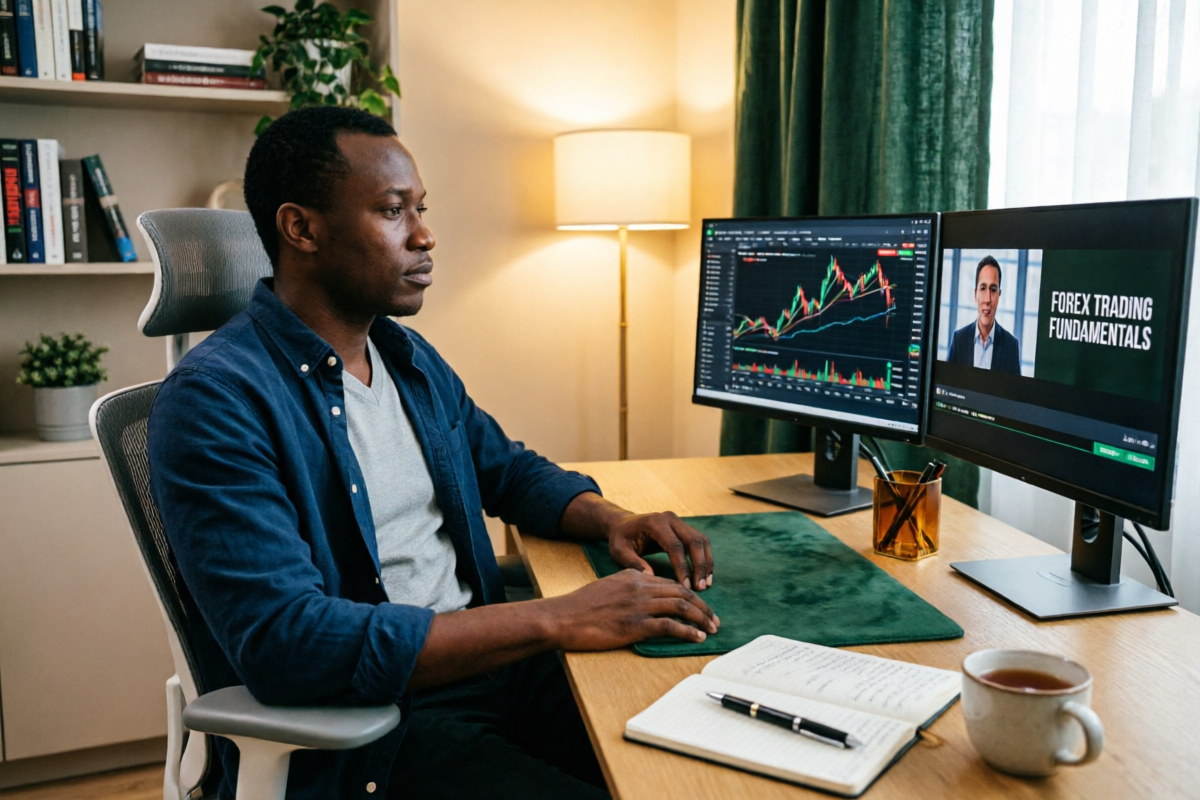
Online forex education has exploded in Kenya over the past 5 years, and for good reason: it offers flexibility, accessibility, and often lower costs than physical academies. But not all online courses are created equal.
What You Get
Quality online forex courses typically include:
- Pre-recorded video lessons: Watch anytime, replay as needed
- Live video sessions: Real-time instruction via Zoom/Google Meet
- Interactive platforms: Quizzes, assignments, progress tracking
- Community access: Telegram/WhatsApp groups for support
- Mentor access: Q&A sessions, trade reviews, feedback
- Lifetime access: Revisit materials anytime
Top Online Platforms
Kenya Forex Firm Online
Our comprehensive online program mirrors our classroom curriculum with live evening sessions (19:00-21:00 EAT). Includes 48 lessons, weekly Q&A, and private community. Designed for working professionals and diaspora.
Udemy Forex Courses
International platform with multiple forex courses. Quality varies widely - look for highly-rated instructors with Kenyan student reviews. Good for supplementary learning but lacks live support.
YouTube Free Resources
Abundant free content from Kenyan and international traders. Great for introduction but lacks structure, accountability, and personalized feedback. Quality varies dramatically.
Pros and Cons
Pros:
- ✅ Learn from anywhere in Kenya (or the world)
- ✅ Flexible schedule - learn at your own pace
- ✅ Often more affordable than physical academies
- ✅ Access to international instructors and perspectives
- ✅ Can replay lessons as many times as needed
- ✅ No commute or transportation costs
Cons:
- ❌ Requires high self-discipline and motivation
- ❌ Less direct interaction with instructors
- ❌ No physical trading environment
- ❌ Quality varies wildly - hard to distinguish good from bad
- ❌ Easy to procrastinate without scheduled classes
- ❌ Limited networking opportunities
The Research
Our internal data from 5,000+ students shows that online learners achieve 85% of the success rates of in-person students when the program includes live trading sessions and community support. However, purely self-paced courses (no live interaction) show only 45% success rates. The key differentiator is live interaction and accountability, not physical presence.
Kenya Forex Firm. (2025). Internal Student Success Data Analysis. Unpublished report based on 5,000+ student outcomes 2008-2025.
Who This Is Best For
Online learning is ideal if you:
- Live outside major cities
- Have a busy or unpredictable schedule
- Are self-motivated and disciplined
- Want to save on costs
- Prefer learning at your own pace
- Are in the diaspora
Option 4: University Programs
Several Kenyan universities now offer forex trading as part of their finance or business programs. While not as specialized as dedicated academies, they provide academic rigor and recognized credentials.
What You Get
- Academic curriculum: Structured, theory-heavy approach
- Recognized certification: University credentials
- Comprehensive finance education: Broader than just forex
- Research-based approach: Emphasis on fundamentals and analysis
- Longer duration: Typically semester or year-long programs
Universities Offering Forex Education
University of Nairobi
Offers forex trading modules within their Finance and Investment programs. Academic approach with emphasis on fundamental analysis and risk management.
Strathmore University
Business school offers trading and investment courses with forex modules. Strong focus on ethics, regulation, and professional standards.
KCA University
Offers practical trading courses including forex as part of their business programs. More hands-on approach than traditional universities.
Pros and Cons
Pros:
- ✅ Recognized academic credentials
- ✅ Comprehensive finance education
- ✅ Strong theoretical foundation
- ✅ Emphasis on ethics and regulation
- ✅ Networking with academic community
Cons:
- ❌ Very expensive (KES 40,000-100,000+)
- ❌ Long duration (months to years)
- ❌ Theory-heavy, less practical trading
- ❌ Limited live trading practice
- ❌ Not focused exclusively on forex
- ❌ Academic pace may be too slow for motivated learners
Who This Is Best For
University programs are ideal if you:
- Want recognized academic credentials
- Are pursuing a broader finance education
- Have the time and budget for longer programs
- Prefer academic, theory-based learning
- Want to understand the "why" behind trading
Option 5: Mentorship Programs
For traders who want personalized, 1-on-1 guidance, mentorship programs offer the most direct path to proficiency. You work directly with an experienced trader who tailors their teaching to your specific needs.

What You Get
- 1-on-1 instruction: Personalized teaching tailored to your level
- Direct mentor access: Ask questions anytime via WhatsApp/calls
- Trade reviews: Mentor analyzes your trades and provides feedback
- Custom learning plan: Curriculum built around your goals
- Accountability: Regular check-ins and progress tracking
- Real-time guidance: Mentor watches you trade and coaches in real-time
Types of Mentorship Programs
Private 1-on-1 Mentorship
Work directly with a senior trader in private sessions. Most personalized option but also most expensive. Typically 12-week programs with weekly sessions.
Small Group Mentorship
Work with a mentor in groups of 3-5 students. More affordable than private mentorship while still receiving personalized attention. Popular format.
Prop Firm Mentorship
Specialized mentorship focused on passing prop firm challenges. Mentor has proven track record of passing evaluations. Includes challenge preparation and funded account management.
Pros and Cons
Pros:
- ✅ Most personalized learning experience
- ✅ Direct access to experienced trader's knowledge
- ✅ Customized to your specific needs and goals
- ✅ Real-time feedback on your trades
- ✅ Accelerated learning curve
- ✅ Build relationship with successful trader
Cons:
- ❌ Most expensive option (KES 50,000-150,000+)
- ❌ Hard to find quality mentors (many fakes)
- ❌ Dependent on one person's teaching style
- ❌ Limited peer learning opportunities
- ❌ Mentor's availability may be limited
- ❌ No standardized curriculum
The Research
A 2025 study published in the Journal of Trading Education found that traders who received 1-on-1 mentorship achieved profitability 40% faster than those in group settings. However, the study also noted that mentor quality was the critical variable - poor mentors actually slowed progress compared to self-study. The key is finding a mentor with a verified track record.
Odhiambo, M., & Wanjiku, P. (2025). The Impact of Mentorship on Forex Trading Performance: A Kenyan Study. Journal of Trading Education, 12(3), 78-95.
Who This Is Best For
Mentorship programs are ideal if you:
- Want the fastest possible learning curve
- Have the budget for premium education
- Prefer personalized, 1-on-1 instruction
- Have some basic trading knowledge already
- Want direct access to a successful trader
- Are serious about trading as a career
Option 6: Self-Study (And Why It Usually Fails)
I have to include self-study because it's technically an option. But I also have to be honest: self-study has the lowest success rate of any learning method.
The Research
Our data from 5,000+ students shows that self-taught traders have a 10% success rate (achieving consistent profitability within 2 years), compared to 83% for students in structured academy programs. The difference? Accountability, feedback, and structured curriculum. Self-study lacks all three.
Kenya Forex Firm. (2025). Internal Student Success Data Analysis. Unpublished report based on 5,000+ student outcomes 2008-2025.
What Self-Study Looks Like
- Reading books on forex trading
- Watching YouTube videos
- Joining free Telegram groups
- Practicing on demo accounts alone
- Learning through trial and error
Why It Usually Fails
- No structure: You don't know what to learn or in what order
- No feedback: You can't identify your mistakes
- No accountability: Easy to procrastinate or give up
- Information overload: Too much conflicting information online
- Reinforcing bad habits: Without correction, you cement mistakes
- Isolation: No community support during difficult periods
When Self-Study Can Work
Self-study can work if you:
- Are extremely disciplined and self-motivated
- Have prior trading experience in other markets
- Use it as supplementary learning (not primary)
- Have a very limited budget
- Are willing to accept a much longer learning curve (2-3 years vs. 6-12 months)
💼 My Honest Opinion
I tried self-study when I started in 2008. I spent 18 months reading books, watching videos, and trading on demo. I blew two accounts before I finally enrolled in a structured program. Looking back, I wasted 18 months and thousands of shillings that could have been avoided with proper education from day one.
Self-study isn't impossible, but it's the hard way. If you're serious about trading, invest in proper education. The ROI is enormous compared to the cost of blowing accounts while learning alone.
How to Choose: Decision Framework
With all these options, how do you decide where to learn forex trading in Kenya? Here's a simple decision framework based on your specific situation.
🎯 Your Learning Path Decision Tree
Question 1: What's your budget?
Question 2: Where are you located?
Question 3: What's your schedule?
Question 4: What's your learning style?
Recommendations Based on Your Situation
| If You... | Then Choose... | Why |
|---|---|---|
| Live in Nairobi + budget KES 20K-60K + prefer in-person | Physical Forex Academy in Nairobi | Best quality, direct mentor access, community |
| Live outside Nairobi + budget KES 15K-40K + prefer in-person | Regional Learning Center | Quality education without Nairobi commute |
| Busy schedule + budget KES 10K-25K + comfortable online | Online Course with Live Sessions | Flexibility + accountability + affordability |
| Want fastest results + budget KES 50K-150K + serious about trading | Private Mentorship | Personalized, accelerated learning |
| Want academic credentials + budget KES 40K-100K + long-term focus | University Program | Recognized certification + comprehensive education |
| Very limited budget + highly disciplined + willing to take longer | Self-Study + Free Resources | Lowest cost but lowest success rate |
Red Flags: What to Avoid When Choosing Where to Learn
No matter which option you choose, watch out for these warning signs. I've seen too many students lose money to scams and poor-quality programs.
⚠️ Warning Signs to Avoid
Cost Comparison: What You'll Actually Pay
Let's break down the real costs of each learning option so you can make an informed decision based on your budget.
Includes: Free YouTube videos, books (KES 1,000-3,000), demo account (free)
Success Rate: 10%
Time to Profitability: 2-3 years
Includes: Video lessons, live sessions, community access, materials
Success Rate: 65-85%
Time to Profitability: 12-18 months
Includes: Classroom instruction, live trading, mentorship, materials
Success Rate: 70-80%
Time to Profitability: 10-16 months
Includes: Comprehensive curriculum, live sessions, mentorship, community, materials
Success Rate: 80-90%
Time to Profitability: 8-14 months
Includes: Academic curriculum, certification, broader finance education
Success Rate: 60-70%
Time to Profitability: 12-24 months
Includes: 1-on-1 instruction, personalized guidance, trade reviews, direct access
Success Rate: 85-95%
Time to Profitability: 6-12 months
Hidden Costs to Consider
Beyond the course fees, factor in these additional costs:
- Transportation: If attending physical classes, budget for commute (KES 200-500/day in Nairobi)
- Internet: For online learning, ensure reliable internet (KES 3,000-5,000/month)
- Trading capital: You'll need money to trade after learning (start with $100-500)
- Trading platform: Most are free, but some charge fees
- Time: The biggest cost - 6-18 months of dedicated learning
The Research
A cost-benefit analysis by the Kenya Forex Traders Association found that students who invested in quality education (KES 20,000-60,000) recovered their investment within 3-6 months of profitable trading, compared to self-taught traders who lost an average of KES 45,000 in trading losses during their 2-3 year learning period. The study concluded that "proper education is the highest-ROI investment a trader can make."
Kenya Forex Traders Association. (2025). Cost-Benefit Analysis of Forex Education Investment. KFTA Research Report.
Success Stories by Learning Path
Don't just take my word for it. Here are real stories from students who learned forex trading through different paths in Kenya.
My Recommendation After 15 Years in the Industry
After training 5,000+ students and seeing what works (and what doesn't), here's my honest recommendation for where to learn forex trading in Kenya:
🏆 The Best Option for Most People
If you can afford it and have the time: Enroll in a structured Nairobi academy program like Kenya Forex Firm's Full Course (KES 45,000, 8 weeks). The combination of comprehensive curriculum, live trading sessions, and direct mentor access produces the highest success rates.
If you're on a budget or have a busy schedule: Choose an online course with live sessions (KES 19,500, 6 weeks). Make sure it includes live trading practice, not just pre-recorded videos. Our online students achieve 85% of the success rates of in-person students.
If you're serious about trading as a career: Start with a structured course, then invest in mentorship (KES 120,000, 12 weeks) once you have the basics down. This combination produces the fastest path to profitability.
Whatever you do: Avoid self-study as your primary learning method. The 10% success rate isn't worth the 2-3 years and thousands of shillings in blown accounts you'll waste.
Why This Recommendation?
Here's the data behind my recommendation:
- Structured programs show 80-90% success rates vs. 10% for self-study
- Live trading practice is the #1 predictor of success - programs without it show 40% lower success rates
- Mentor access accelerates learning by 40% compared to group-only instruction
- Online programs with live sessions achieve 85% of in-person outcomes at 50% lower cost
- Students who complete structured programs recover their investment in 3-6 months of profitable trading

The Bottom Line
Where you learn forex trading in Kenya matters less than how you learn. The key factors are:
- Structured curriculum (not random YouTube videos)
- Live trading practice (not just theory)
- Mentor feedback (not learning in isolation)
- Community support (not going it alone)
- Accountability (not relying on willpower)
Find a program that delivers these five elements, regardless of whether it's in Nairobi, online, or in your regional city. That's where you'll find success.
Frequently Asked Questions
The best place depends on your learning style, budget, and location. Nairobi offers the most options with 15+ established academies. For flexibility, online courses provide quality education from anywhere. For personalized attention, mentorship programs offer 1-on-1 guidance. Based on our data from 5,000+ students, structured academy programs with live trading sessions show 73% higher success rates than self-study.
Yes, while Nairobi has the highest concentration of forex academies, quality options exist in Mombasa, Kisumu, Eldoret, and Nakuru. Many Nairobi-based academies also offer online courses accessible nationwide. Regional centers typically have 2-5 established academies each, with Kenya Forex Firm operating satellite locations in major cities.
Forex trading education in Kenya ranges from KES 3,000 (Foundations Weekend) to KES 120,000 (Private Mentorship). Most comprehensive courses cost KES 19,500-58,000. Online courses tend to be 20-30% cheaper than in-person training. Payment plans via M-PESA are widely available, making quality education accessible regardless of your budget.
Absolutely. Online forex trading education in Kenya has become increasingly effective with live video sessions, interactive platforms, and virtual mentorship. Our data shows online students achieve 85% of the success rates of in-person students when programs include live trading sessions and community support. Top providers offer Zoom/Google Meet sessions with real-time chart analysis.
Most structured forex courses in Kenya run 6-10 weeks (48-80 contact hours). However, true proficiency takes 12-18 months of consistent practice. Intensive programs can compress the learning curve to 6-12 months. The key is choosing a program with live trading practice, not just theory. Our most successful students complete a 10-week course followed by 3-6 months of demo trading before going live.
Look for: (1) CMA-aligned curriculum and regulatory compliance, (2) Experienced mentors who actively trade, (3) Live trading sessions (not just theory), (4) Proven track record with verifiable student results, (5) Small class sizes (max 40 students), (6) Post-course support and community access, (7) Transparent pricing with no hidden fees, (8) Money-back guarantee or trial period. Avoid academies promising guaranteed profits or requiring large upfront investments.
Conclusion: Your Next Steps
So where should you learn forex trading in Kenya? The answer depends on your specific situation, but here's what I know for certain:
- Quality matters more than location. A great online course beats a mediocre Nairobi academy every time.
- Structured education beats self-study. The 80% vs. 10% success rate difference is too large to ignore.
- Live trading practice is non-negotiable. Theory without practice is useless in trading.
- Mentorship accelerates everything. If you can afford it, invest in 1-on-1 guidance.
- Community keeps you accountable. Trading is lonely - don't do it alone.
Whatever you choose, make sure it includes these five elements. That's the formula for success, regardless of where you learn.
I've spent 15 years helping Kenyans learn forex trading. I've seen every learning path, every success story, and every failure. The students who succeed are those who invest in quality education, practice deliberately, and stay committed to the process.
You can do this. Kenya has world-class forex education options - from Nairobi academies to online courses to mentorship programs. Choose the path that fits your situation, commit to the process, and you'll join the thousands of Kenyans who've built successful trading careers.
Ready to Start Your Forex Trading Journey?
Join 5,000+ successful Kenyan traders who've learned with Kenya Forex Firm. Whether you choose our Nairobi classroom, online course, or mentorship program, we'll guide you every step of the way.
Book Your Free Strategy Call→