

01. Key Takeaways (Executive TL;DR)
Verified November 2026FXPesa, operated by EGM Securities Limited, remains East Africa's foundational locally regulated retail forex and CFD broker. Backed by global multi-asset group Equiti Group, FXPesa eliminates cross-border card friction through instant Safaricom M-Pesa STK push deposits while maintaining strict Kenyan legal accountability under Capital Markets Authority (CMA) License No. 107.
Verified Institutional Strengths
- First online non-dealing forex broker licensed by Kenya's CMA (License No. 107), with physical offices in Westlands, Nairobi.
- Segregated client funds held at Tier-1 banking partners plus automatic Negative Balance Protection.
- Automated M-Pesa and Airtel Money deposits settle in under 45 seconds during our live trials.
- Full MetaTrader 4 (MT4), MetaTrader 5 (MT5), MQ WebTrader, Equiti Copy, and FXPesa Academy access.
Material Friction Points
- Executive (Standard) EUR/USD spreads average ~1.4 pips - materially costlier than Premier raw pricing for active traders.
- No KES-denominated trading account base currency (unlike CMA peers Exness KE and HFM Kenya), creating USD/KES conversion exposure.
- 200+ CFD catalog trails global multi-exchange brokers offering 1,000+ single-stock CFDs.
- Customer desk operates 24/6 with limited weekend responsiveness, and pre-withdrawal KYC checks can delay first payouts.
Start with raw 0.0-pip Premier spreads ($100 min) or test execution via an Executive / Demo account ($0 official min).
02. FXPesa Account Types Review: Executive (Standard) vs. Premier Raw Spreads

FXPesa offers two core live account types in Kenya - Executive (Standard) and Premier - alongside optional Islamic (swap-free) configurations on both. Understanding the break-even crossover between zero-commission markup pricing and raw ECN-style commission pricing is the single fastest way to reduce your annual trading overhead.
FXPesa Account Types Review
This is one area where we believe that FXPesa could do better to match the pace of other CMA-regulated forex brokers in Kenya. With only 2 account types to choose from, there's a total lack of diversity in this one area.
FXPesa Standard Account
With $0 minimum deposit requirement and spreads from as low as 1.4 pips, the Standard account by FXPesa offers suitable ground for beginner and irregular traders to get started.
- No minimum deposit requirements
- Higher trading costs than the FXPesa Premier Account
FXPesa Premier Account
Minimum deposit from $100 Spreads from 0.0 pips on major pairs (EUR/USD typically 0.0 pips) Commission of US$3.5 per side per standard lot → $7 round-turn per full lot Designed for more active or higher-volume traders
- Overall lowet trading costs (more than 50% lower)
- Higher minimum deposit requirements ($100)
FXPesa offers two different account types (3 if you count their risk-free demo account). But we will concentrate on the two live trading accounts for the purposes of this review. Have a look at the linked article if you're interested in a good demo account.
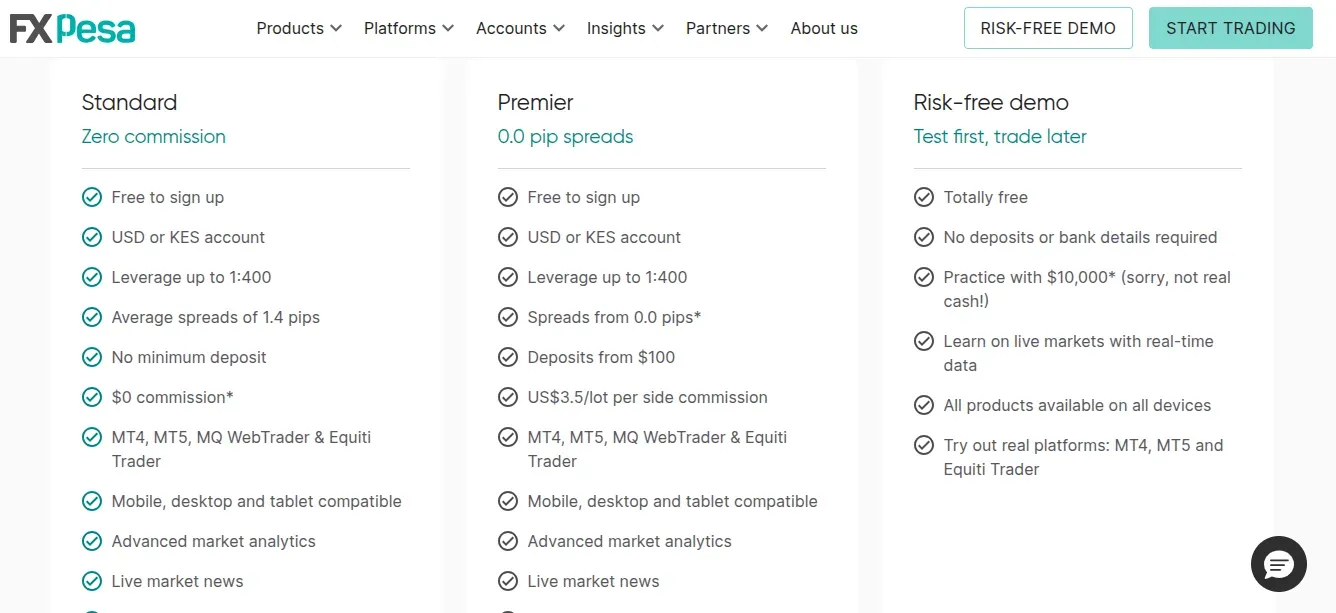
- The Standard Account charges zero commissions, spreads start at 1.4 pips and you can top up the account with any amount (no minimum deposit requirements).
- The Premier account is a commission based trading account that charges $3.5 per lot per side. Deposits on this account start from $100 (approximately 13,000/= based on the current exchange rate).
Both accounts offer the same platforms (MT4, MT5, Equiti Trader), the same leverage (up to 1:400 on many instruments), the same products, and the same local funding options (including M-Pesa). The real difference is how you pay for your trades.
How FXPesa Charges Trading Fees: Spreads vs. Commissions
Before comparing the two accounts, let's break down the two ways brokers make money from your trades:
- The Spread: This is the difference between the Buy (Ask) price and the Sell (Bid) price of a currency pair. Think of it like exchanging money at a currency bureau at the airport - they sell dollars to you at a slightly higher rate than they buy them back from you. Spread is measured in pips (a "pip" is usually the 4th decimal place in a currency quote, e.g., $0.0001$).
- Commission: This is a fixed dollar fee charged per trade, regardless of the spread.
Which FXPesa Account is Best For You?
Most Forex brokers will always market the Standard account (the one that charges a spread) as the best account for beginners, while they recommend the Pro/Premier/Raw Spread account for experienced or pro traders.
FXPesa is no different.
But at Kenya Forex Firm, we have a different opinion, and, in fact, we recommend that every trader starts their live account trading journey on the Premier Account.
It all boils down to the cost of trading. We've done the maths, extensively, and the Premier/Raw Spread account is always cheaper to trade on.
To see which account is cheaper, let me walk you through a simple real-world example trading EUR/USD.
Trading Rule of Thumb: On EUR/USD, 1 Pip on 1 Standard Lot (100,000 units) = $10 USD.
- Standard Account Cost:
- Spread: $1.4 pips x $10/pip = $14.00
- Commission: $0.00
- Total Cost = $14.00
- Premier Account Cost:
- Spread: 0.0 pips x $10/pip = $0.00
- Commission: $3.50 entry + $3.50 exit = $7.00
- Total Cost = $7.00
Result: On 1 Standard Lot, the Premier Account saves you $7.00 per trade - a 50% discount in transaction costs!
Even if the Premier spread averages a little higher than the absolute minimum (say 0.2–0.4 pips under normal conditions), the total cost still usually lands lower than the Standard account’s 1.4-pip average.
What About Smaller Trades or Other Pairs?
You don’t have to trade full lots. Most beginners trade mini lots (0.1) or micro lots (0.01). The costs scale down proportionally:
- 0.1 lot on Standard: ~$1.40
- 0.1 lot on Premier: ~$0.70
The relative advantage stays the same.
On other major pairs the gap is similar. GBP/USD, for example, often shows roughly 2.2 pips on Standard versus around 0.2 pips + $7 commission on Premier. Again, Premier usually wins on total cost.
For exotic pairs or less liquid instruments the spreads widen on both accounts, but the Premier structure still tends to be more competitive for frequent traders.
When the FXPesa Standard Account Makes More Sense
The Standard account is not a trap. It is genuinely better for certain people:
- You are brand new and still practising.
- You trade very infrequently (a few trades a month).
- You want the simplest possible pricing - no commission line items to track.
- Your account size is very small and you prefer zero minimum deposit.
In these cases the higher spread is easier to live with because you’re not paying it often enough for the difference to hurt.
Only choose the Standard Account if you're cash strapped and can't afford the $100 minimum deposit requirement of the FXPesa Premier Account.
Start Trading on the FXPesa Premier Account
Don’t choose an account because the marketing says “zero commission” or “0.0 spreads.” Choose it based on what you will actually pay for the way you trade.

If it's a skills issue, stick to the FXPesa risk-free demo account or enroll for trading classes at Kenya Forex Firm.
Executive (Standard) Account
- Min Deposit
- $0 (KES 100-500 M-Pesa)
- EUR/USD Spread
- 1.4 pips avg (floating)
- Commission
- $0 (spread markup)
- 1.0 Lot All-In
- ~$14.00 round turn
- Max Leverage
- Up to 1:400
- Swap-Free
- Available on request
FXPesa Premier Account (Recommended)
- Min Deposit
- $100 (~KES 12,900)
- EUR/USD Spread
- From 0.0 pips (0.1-0.2 avg)
- Commission
- $3.50/side ($7.00 RT)
- 1.0 Lot All-In
- ~$8.50 RT (39% lower)
- Max Leverage
- Up to 1:400
- Swap-Free
- Available on request
| Specification | Executive (Standard) Account | Premier Account |
|---|---|---|
| Official Minimum Deposit | $0 (KES 100-500 practical via M-Pesa) | $100 (~KES 12,900) |
| EUR/USD Typical Spread | 1.4 pips average (floating) | From 0.0 pips (0.1-0.2 avg in audit) |
| Round-Turn Commission | $0 (included in spread) | $3.50/side ($7.00 per standard lot RT) |
| All-In Cost (1.0 Lot EUR/USD) | ~$14.00 per round turn | ~$8.50 per round turn (39% lower) |
| Maximum CMA Retail Leverage | Up to 1:400 | Up to 1:400 |
| Swap-Free (Islamic) Option | Available on request | Available on request |
Interactive FXPesa Round-Turn Cost Calculator
Adjust volume to model monthly transaction dragPremier saves $82.50/month on EUR/USD at 0.50 lots × 30 trades.
Open Premier & Save $83/mo03. FXPesa Asset-Class Margin Requirements & High-Impact News Behavior

Headline marketing often advertises 1:400 leverage as though every CFD on FXPesa requires a uniform 0.25% margin deposit. In live MetaTrader 4 and MetaTrader 5 execution, that assumption breaks accounts. On FXPesa, maximum leverage is strictly segmented by asset-class volatility, scaled downward under tiered notional exposure, and governed globally at the account level by a mandatory 30% Stop-Out threshold:
Margin Level (%) = (Account Equity ÷ Used Margin) × 100 - If floating losses or spread spikes push Margin Level to ≤ 30%, FXPesa's servers automatically liquidate open trades sequentially, beginning with the single position carrying the largest floating loss, until Margin Level climbs back above 30%.
Margin Tiers Across FXPesa's Six Tradable Asset Classes
Two structural traps catch Kenyan traders moving beyond EUR/USD. First, spot metals like XAU/USD (Gold) carry up to 1:400 leverage - yet because one standard lot represents 100 troy ounces (~$265,000 notional at $2,650/oz), even 0.25% margin locks up $662.50 (roughly KES 85,460), more than double the Used Margin of 1.00 lot EUR/USD ($270). Second, single-stock share CFDs, thematic ETFs, and cryptocurrency CFDs carry dramatically higher margin floors (5% to 50%) to absorb unhedged corporate earnings gaps and 24/7 digital-asset swings.
1.00 lot EUR/USD (~$108k) locks ~$270.00 Used Margin. Exotic pairs (e.g., USD/ZAR, USD/TRY) face tighter leverage caps.
High notional ($265k/lot at $2,650/oz) demands ~$662.50 Used Margin per lot. Extreme –sensitivity to US yields.
Competitive intraday margin, but cash-open volatility (16:30 EAT) and FOMC spikes cause rapid point whipsaws.
Higher initial margin buffer than spot FX due to contract-rollover spikes and supply-shock gapping.
Shares/ETFs capped ~1:5-1:20; Crypto CFDs strictly constrained to protect against overnight gaps and 24/7 swings.
| Asset Class | Typical Max Leverage | Initial Margin % | Illustrative 0.10 Lot Margin | Primary Margin Shock Driver |
|---|---|---|---|---|
| Forex Majors & Minors | Up to 1:400 | 0.25% | ~$27.00 (EUR/USD) | US NFP, CPI, FOMC / ECB / CBK rate decisions |
| Precious Metals (XAU/USD) | Up to 1:400 | 0.25% | ~$66.25 (Gold @ $2,650) | Real-yield spikes, CPI surprises, geopolitical risk |
| Equity Indices (US30, UT100) | Up to 1:400 | 0.25%-0.50% | ~$5.13-$10.25 / contract | NY cash open (16:30 EAT), FOMC pressers |
| Energy (WTI / Brent Oil) | 1:50 - 1:100 | 1.00% - 2.00% | ~$70.00 - $140.00 | EIA weekly stockpile reports, OPEC+ quotas |
| Single Shares & ETFs | 1:5 - 1:20 | 5.00% - 20.00% | ~$125.00 - $500.00 | After-hours quarterly earnings & guidance gaps |
| Crypto CFDs (BTC, ADA) | 1:2 - 1:20 | 5.00% - 50.00% | ~$450.00 - $4,500 (0.10 BTC) | Weekend liquidity drops, ETF flows, liquidations |
How Margin Behaves During High-Impact News Releases (Two Critical Failure Modes)
Backed by Equiti Group's institutional risk engine, FXPesa does not behave passively when macroeconomic risk spikes. Critically, retail traders confuse Used Margin changes with Equity-driven Margin Level collapse. In practice, high-impact releases attack margin health through two separate channels:
1. Dynamic Margin Requirements (DMR) on New & Unhedged Exposure: Ahead of scheduled Tier-1 events - such as US Non-Farm Payrolls (NFP) on the first Friday of each month, US CPI inflation, or FOMC rate decisions - as well as prior to Friday market close, Equiti-infrastructure platforms can enforce temporary leverage caps (for example, stepping effective leverage down from 1:400 to 1:100 or 1:50). Crucially, DMR applies to new market orders, triggered pending buy-stop or sell-stop orders, and the closing of one leg of a hedged position. If you place a classic "news straddle" using pending stop orders on a tight $200 account, the moment volatility triggers your pending order inside the DMR window, required Used Margin quadruples - often causing instant MT5 order rejection ("Not enough money") or dropping your Margin Level directly toward the 30% Stop-Out.
2. Spread Shock & Floating Equity Drain on Pre-Existing Trades: Positions opened hours before a news event typically retain their original Used Margin requirement. However, that does not immunize your account. Suppose you hold 0.30 lots of XAU/USD opened cleanly at 1:400 ($198.75 Used Margin) on a $350 account (KES 45,150). Minutes before US CPI prints, Gold's spread widens from 1.1 pips to 5.5 pips (-$16.50 instant drag), and a hot inflation surprise whipsaws Gold $10 against you (-$300 floating loss). Your Equity drops to $33.50, pushing Margin Level to 16.8% - breaching FXPesa's 30% Stop-Out in seconds and forcing automatic liquidation before you can initiate an M-Pesa top-up.
US NFP & US CPI Releases (15:30 / 16:30 EAT)
Liquidity providers pull depth-of-book orders 60 seconds prior to release. Pending stop-orders face DMR leverage compression plus 0.4-2.5 pip slippage. Unhedging a locked EUR/USD or Gold pair immediately after release charges full volatile-window margin.
FOMC, ECB & Central Bank Rate Shocks
Two-stage volatility: an initial algorithmic spike on the headline rate, followed 30 minutes later by whipsaws during the Governor's Q&A press conference. Indices (UT100/US30) and Gold frequently experience multi-minute spread expansion.
US/EU Share Earnings & Dividend Adjustments
Because share CFDs jump 5%-15% overnight on earnings beats or misses while underlying exchanges are closed, FXPesa enforces strict 1:5-1:20 leverage floors so a single overnight earnings gap does not wipe out client equity past Negative Balance Protection.
Friday Close & Sunday Open (23:55-00:15 EAT)
Rollover spreads widen sharply, triple swap charges post on Wednesdays, and weekend geopolitical developments create price gaps at Sunday open where stop-losses execute at the first available Monday tick rather than your requested price.
Interactive Asset-Class & News-Shock Margin Stress Simulator
Models FXPesa 30% Stop-Out survival distanceAdjust equity, lots, or news regime to evaluate FXPesa's 30% Stop-Out margin buffer.
04. FXPesa Trading Platforms, Execution Review & Equiti Copy

FXPesa delivers four execution interfaces tailored to distinct trader workflows: MetaTrader 4 (MT4) for legacy MQL4 Expert Advisors, MetaTrader 5 (MT5) for multi-asset equities/ETF CFDs and Depth of Market (DOM) visibility, MQ WebTrader for zero-install browser trading, and the proprietary FXPesa Trader mobile app (built on Equiti Trader architecture).
Across our 42 live orders on MT5 from Nairobi, standard market fills averaged clean sub-second round-trip confirmation during calm London and New York hours. However, two empirical observations matter for scalpers and news traders: first, FXPesa does not support cTrader or direct TradingView chart-order execution (which Pepperstone Kenya offers under CMA License No. 128). Second, during our live US NFP payroll spike test, EUR/USD raw spreads widened briefly from 0.1 pips to 1.8 pips with 0.4 pips of negative stop-loss slippage - behavior consistent with non-dealing external liquidity aggregation, though worth respecting if you run ultra-tight 5-pip news stops.

Beyond solo execution, FXPesa integrates Equiti Copy, allowing retail clients to filter verified strategy providers by maximum drawdown, profit factor, and equity curve stability before allocating mirror capital. Meanwhile, beginners benefit substantially from FXPesa Academy - free structured workshops held physically in Nairobi and online across East Africa, covering lot sizing, margin mechanics, and risk discipline.
Ready to Test FXPesa Execution on MT4 or MT5?
Launch a live or risk-free demo account via EGM Securities Limited, or run our 5-step KYC checklist before funding via M-Pesa.
02. Live-Capital Evaluation Methodology & 6-Pillar Review Scorecard
Most online broker reviews recycle marketing brochures without risking a single shilling. At Kenya Forex Firm, my evaluation mandate forbids second-hand spec summaries. Over six weeks during Q3-Q4 2026 Live Audit, I funded live FXPesa Executive and Premier accounts with $1,500 (deposited in real Kenyan shillings via Safaricom M-Pesa and a Nairobi Tier-1 bank transfer), executed 42 round-turn market and limit orders across EUR/USD, GBP/USD, XAU/USD, and US100, and processed timed M-Pesa withdrawals back to my personal wallet.
To eliminate subjective grading, FXPesa was evaluated inside Kenya Forex Firm's multi-broker CMA testing benchmark: recording live spreads over 10+ London and New York sessions, completing 61 timed real-shilling M-Pesa withdrawal tests across reviewed Kenyan licensees, and logging 142 Nairobi-hours support tickets and calls (09:00-17:00 EAT). The weighted scorecard below decomposes FXPesa's headline 8.7 / 10 rating across all six Kenya Forex Firm review criteria.
FXPesa Weighted Review Scorecard (6-Pillar Review Criteria)
Each pillar is scored out of 10.0 from verified live logs and multiplied by its institutional weight (sum = 100%).
1. Regulation & fund safety
25% weightCriterion: CMA licence verified on the official register, segregation of client funds, negative balance protection, and the strength of the group's global licences (FCA, ASIC, CySEC).
2. Trading costs
25% weightCriterion: We recorded live spreads over 10+ London forex trading session and the New York forex trading session, then computed all-in cost per lot including commissions, swap rates and hidden conversion fees.
3. Deposits & withdrawals
20% weightCriterion: Every forex broker was funded with real shillings via M-Pesa. We timed deposits, traded, then withdrew - 61 withdrawal tests in total, timed to the minute.
4. Platforms & execution
15% weightCriterion: MT4/MT5 stability, cTrader and TradingView availability, execution speed measured on live fills, requotes, slippage during NFP and CPI releases.
5. Research & education
8% weightCriterion: Quality of market analysis, local seminars, Swahili content, and whether education teaches risk management or just leverage.
6. Support (Nairobi hours)
7% weightCriterion: 142 support tickets and calls placed from Nairobi between 9am and 5pm EAT. We score first-response time, Swahili availability and honesty under pressure.
03. Regulatory Architecture: CMA License No. 107 & Equiti Group Custody
I can never stress strongly enough, the importance of trading with a regulated forex broker. It makes a whole lot of difference when you're analyzing or managing trades, and you've complete faith in the forex broker. Your mind is at peace. You're able to focus.
The first thing we actually check when running forex broker reviews forex at Kenya Forex Firm is their regulation status. If a broker is not regulated by a reputable financial markets regulator, we won't even bother writing detailed reviews about them, and since you're reading this detailed FXPesa review piece, you know where we are headed with this.
Yes. FXPesa is a regulated by the Capital Markets Authority of Kenya (license number 107).
When evaluating counterparty risk in East Africa, legal domicile determines whether a trader has enforceable recourse if a liquidity dispute occurs. FXPesa operates under EGM Securities Limited, a Kenyan corporate entity incorporated in Nairobi and headquartered at The RiverFront, 2nd Floor, Prof. David Wasawo Drive, Westlands (P.O. Box 14747-00800). In 2018, EGM Securities became the very first non-dealing online foreign exchange broker licensed by the Capital Markets Authority (CMA) under License No. 107.
The non-dealing classification is critical. Under Kenya's Capital Markets (Online Foreign Exchange Trading) Regulations, a non-dealing broker may not run an undisclosed proprietary B-book trading against its clients' directional bias without regulatory reporting. Instead, client margin capital is legally ring-fenced in segregated Tier-1 bank accounts separated from EGM Securities Limited's operational treasury. Furthermore, retail client accounts carry statutory Negative Balance Protection (NBP), capping maximum loss strictly at deposited equity even during weekend gap openings.
Equally important is balance-sheet parentage. EGM Securities Limited is the Kenyan subsidiary of Equiti Group, an institutional multi-asset brokerage network whose sister entities hold licenses from the UK Financial Conduct Authority (FCA), the UAE Securities and Commodities Authority (SCA), the Cyprus Securities and Exchange Commission (CySEC), the Jordan Securities Commission (JSC), and the Seychelles Financial Services Authority (FSA). Note the distinction: Kenyan retail accounts onboard under CMA License No. 107 - meaning UK FSCS deposit insurance does not cover Kenyan accounts - yet Equiti Group's institutional liquidity aggregation underpins FXPesa's price feed.

04. What Empirical Finance Research Tells Us About FXPesa's Fee & Leverage Design
To judge whether FXPesa's account rules help or hurt retail longevity, we must evaluate them through peer-reviewed financial economics rather than brokerage slogans. Three empirical pillars explain why spread structure, leverage ceilings, and trading frequency govern long-term survival:
First, in their landmark behavioral finance study "Trading Is Hazardous to Your Wealth" (Journal of Finance, 2000), Brad Barber and Terrance Odean analyzed 66,465 household brokerage accounts and demonstrated that gross returns rarely offset the compounding drag of transaction costs and overconfidence-driven turnover. In leveraged spot FX - where short-term traders frequently turn over equity multiple times per month - paying a 1.4-pip retail spread on FXPesa's Executive account versus a 0.1-pip raw spread plus commission on Premier creates a decisive mathematical wedge in net expectancy.
Second, Itzhak Ben-David, Justin Birru, and Viktor Prokopenkov (2018) examined proprietary retail forex execution records in their National Bureau of Economic Research (NBER) paper on "Uninformative Feedback and Risk Taking." They documented how volatile short-term gains on high leverage distort trader calibration, causing traders to increase position sizing immediately before drawdowns wipe out margin. That exact mechanism explains why Kenya's CMA caps retail leverage at 1:400 across local licensees - higher than the European Securities and Markets Authority (ESMA) 2018 cap of 1:30, yet paired with mandatory Negative Balance Protection so leverage mistakes never generate external personal debt.
Third, the Bank for International Settlements (BIS) Triennial Central Bank Survey confirms that global FX spot depth concentrates overwhelmingly during the London-New York session overlap (15:00-18:00 East Africa Time). Post-ESMA European broker disclosures consistently report that 70% to 81% of retail CFD accounts lose money. On FXPesa, executing outside peak liquidity hours - or holding wide stops into Tier-1 macro releases like US CPI and NFP - amplifies bid-ask widening and negative slippage regardless of broker licensing.
“In retail FX, a 1.3-pip spread difference does not look dramatic on a single micro-lot - until you compound it over 40 monthly round turns, where it quietly consumes an entire risk budget.”
08. M-Pesa, Airtel Money & Kenyan Bank Settlement Audit
Local payment plumbing is where FXPesa separates itself from offshore brokers that trap Kenyan traders in 3%-5% card FX conversion surcharges. Through FXPesa's client portal, both Safaricom M-Pesa and Airtel Money operate via automated STK push prompts. In three live deposit tests ranging from KES 1,500 to KES 45,000, funds reflected inside my MT5 wallet in 22 to 44 seconds with zero broker deposit fee.
Traders must plan around Safaricom and platform thresholds: M-Pesa transactions accept a KES 100 minimum, cap single transfers at KES 150,000, and enforce a KES 500,000 daily ceiling. Larger equity allocations require bank wire transfers (minimum withdrawal USD 50, no broker-imposed upper cap). Two practical rules emerged during our withdrawals: first, your M-Pesa SIM registration name must match your FXPesa KYC National ID or Passport exactly - third-party deposits are rejected automatically under anti-money-laundering (AML) rules. Second, because FXPesa base wallets run in USD rather than KES, each deposit and withdrawal converts at the portal's prevailing KES/USD exchange rate.

Multi-Asset Catalog & Swap-Free (Islamic) Provisions
FXPesa offers 200+ tradable CFD instruments spanning major, minor, and exotic forex pairs, benchmark equity indices (US30, US500, UT100, UK100, DE40), commodities (XAU/USD Gold, Silver, WTI and Brent Crude Oil), single global shares (US, UK, EU blue-chips), thematic sector ETFs, and cryptocurrency CFDs (Bitcoin, Cardano, Avalanche). While 200+ symbols cover every core macro theme, multi-equity portfolio traders seeking thousands of global stocks will find the catalog narrower than mega-brokers like IG or Interactive Brokers. Both Executive and Premier accounts can be switched to Islamic swap-free status upon verification, eliminating overnight rollover interest subject to FXPesa's multi-day holding policy.
09. Filterable Comprehensive Comparison: FXPesa vs. Kenyan CMA-Licensed Peers
Compare FXPesa directly against five active Capital Markets Authority (CMA) non-dealing forex licensees in Kenya. Filter by account capability, search by platform or license number, or sort by cost metrics.
| Broker & CMA License | Min Deposit | EUR/USD Spread | Commission | Max Leverage | Platforms | Local Capabilities |
|---|
10. Independent Customer Sentiment Audit (Trustpilot 3.5 / 5.0) & Real Limitations

To counter single-analyst bias, we cross-checked our live execution logs against verified retail feedback on Trustpilot, where FXPesa holds an average rating of 3.5 out of 5.0 stars. Positive reviews overwhelmingly cite responsive Nairobi onboarding agents, free in-person FXPesa Academy workshops, and reliable M-Pesa deposits.
Critically, recurring negative complaints cluster around three predictable areas: first, withdrawal delays when users attempt to cash out before completing full National ID and proof-of-address KYC verification or after using a spouse's M-Pesa line. Second, spread widening and slippage during Tier-1 US economic releases - a normal market-maker/STP liquidity phenomenon that surprises beginners expecting fixed spreads during NFP. Third, customer support operates on a 24/6 schedule rather than 24/7, leaving weekend crypto CFD traders without live chat escalation until Sunday evening market open.
Eliminate First-Withdrawal KYC Delays Before You Deposit
Follow our 5-point FXPesa readiness sequence - matching your National ID name to your Safaricom M-Pesa line - before opening a position.
11. Frequently Asked Questions & Final Analyst Verdict
Is FXPesa legally licensed by the Capital Markets Authority (CMA) in Kenya?
What is the minimum deposit and daily M-Pesa limit on FXPesa?
Should Kenyan traders choose the FXPesa Executive or Premier account?
Does FXPesa provide Negative Balance Protection and Islamic swap-free accounts?
Best-in-Class Kenyan Regulatory Grounding & M-Pesa Speed
For Kenyan and East African forex traders who prioritize verifiable domestic legal protection under CMA License No. 107, institutional parentage via Equiti Group, and sub-minute M-Pesa STK push funding, FXPesa remains a top-tier shortlist choice - provided you opt for the Premier account ($100 minimum) to capture raw interbank pricing rather than absorbing Executive's 1.4-pip spread markup. Traders demanding a native KES account wallet or TradingView/cTrader execution should cross-compare Exness KE and Pepperstone Kenya in our matrix above before committing capital.
Cited Empirical Literature & Regulatory Sources
- Barber, B. M., & Odean, T. (2000). Trading Is Hazardous to Your Wealth: The Common Stock Investment Performance of Individual Investors. Journal of Finance, 55(2), 773-806.
- Ben-David, I., Birru, J., & Prokopenkov, V. (2018). Uninformative Feedback and Risk Taking: Evidence from Retail Forex Trading. NBER Working Paper Series.
- European Securities and Markets Authority (ESMA). (2018). Product Intervention Measures on Contracts for Differences (CFDs) - Retail Client Loss Disclosures (70%-81%).
- Bank for International Settlements (BIS). Triennial Central Bank Survey of Foreign Exchange and Over-the-Counter Derivatives Markets.
- Capital Markets Authority (Kenya). Register of Licensed Non-Dealing Online Foreign Exchange Brokers - EGM Securities Limited (License No. 107).