Asian Session Forex Time in Kenya: The Definitive Institutional Guide (EAT)
A comprehensive, data-backed analysis of Tokyo trading hours, liquidity microstructure, Gotobi fixing dynamics, and CMA-regulated broker execution for active traders in Nairobi and across East Africa.
Lead Financial Markets Analyst & Forex Veteran (Kenya)
Patrick Mahinge
Lead Financial Markets Analyst & Forex Veteran (Kenya)
Patrick Mahinge is a distinguished Kenyan financial markets analyst, macroeconomics researcher, and veteran retail currency trader. With over 14 years analyzing African capital markets, currency flows, and fintech infrastructure, Patrick has guided thousands of Kenyan traders through institutional-grade risk management and broker due diligence. He is an outspoken advocate for CMA regulatory compliance, investor protection, and transparent retail trading execution in East Africa.
Exact Operating Hours: The core Tokyo Asian session runs strictly from 3:00 AM to 12:00 PM (Noon) EAT. Sydney initiates broader Asia-Pacific liquidity at 12:00 AM (Midnight) EAT.
✓
Zero Daylight Saving Disruptions: Kenya operates on East Africa Time (UTC+3) and Japan operates on Japan Standard Time (UTC+9). Neither jurisdiction observes Daylight Saving Time, keeping the time differential locked at exactly 6 hours year-round.
✓
Most optimal windowThe Tokyo-London overlap (10:00 AM - 12:00 PM EAT) is the golden window for Kenyan traders, combining Asian and European liquidity for maximum opportunity.
✓
The 3:55 AM EAT Tokyo Fixing: The commercial rate fix at 9:55 AM JST sparks concentrated JPY liquidity, particularly on Japanese "Gotobi days" (5th, 10th, 15th, 20th, 25th, and 30th of every month).
✓
Primary Liquid Pairs: USD/JPY commands over 70% of Tokyo regional liquidity with spreads under 0.8 pips. AUD/JPY and NZD/USD present prime range and news-trading alternatives during Asian central bank releases.
✓
Pre-Work Window for Professionals: 5:00 AM to 8:00 AM EAT offers disciplined, range-bound price action before the morning commute along Nairobi's Mombasa Road, Waiyaki Way, or Thika Superhighway.
✓
Local CMA Safeguards: Trade exclusively through brokers licensed by Kenya's Capital Markets Authority (CMA) with instant Safaricom M-Pesa clearing and local segregated accounts.
03:00 - 12:00
Tokyo Core Hours (EAT)
UTC+3 / UTC+9
Fixed 6-Hour Time Difference
03:55 AM
Tokyo Fixing Order Surge (EAT)
< 0.9 Pips
Tested USD/JPY Spread (CMA ECN)
1. The Macro Structure of Asian Session Forex Time in Kenya
When trading currencies from Nairobi, Mombasa, Kisumu, or Eldoret, understanding international market hours is not merely an exercise in arithmetic; it is the fundamental foundation of capital preservation. Kenya operates on East Africa Time (EAT), which is calibrated to UTC+3. Because Kenya sits directly on the equator, the country does not observe Daylight Saving Time (DST).
Similarly, Japan operates on Japan Standard Time (JST / UTC+9) and does not practice daylight saving adjustments. This mutual absence of seasonal clock shifts provides Kenyan forex traders with an immense logistical advantage: Tokyo is always exactly 6 hours ahead of Nairobi, 365 days a year.
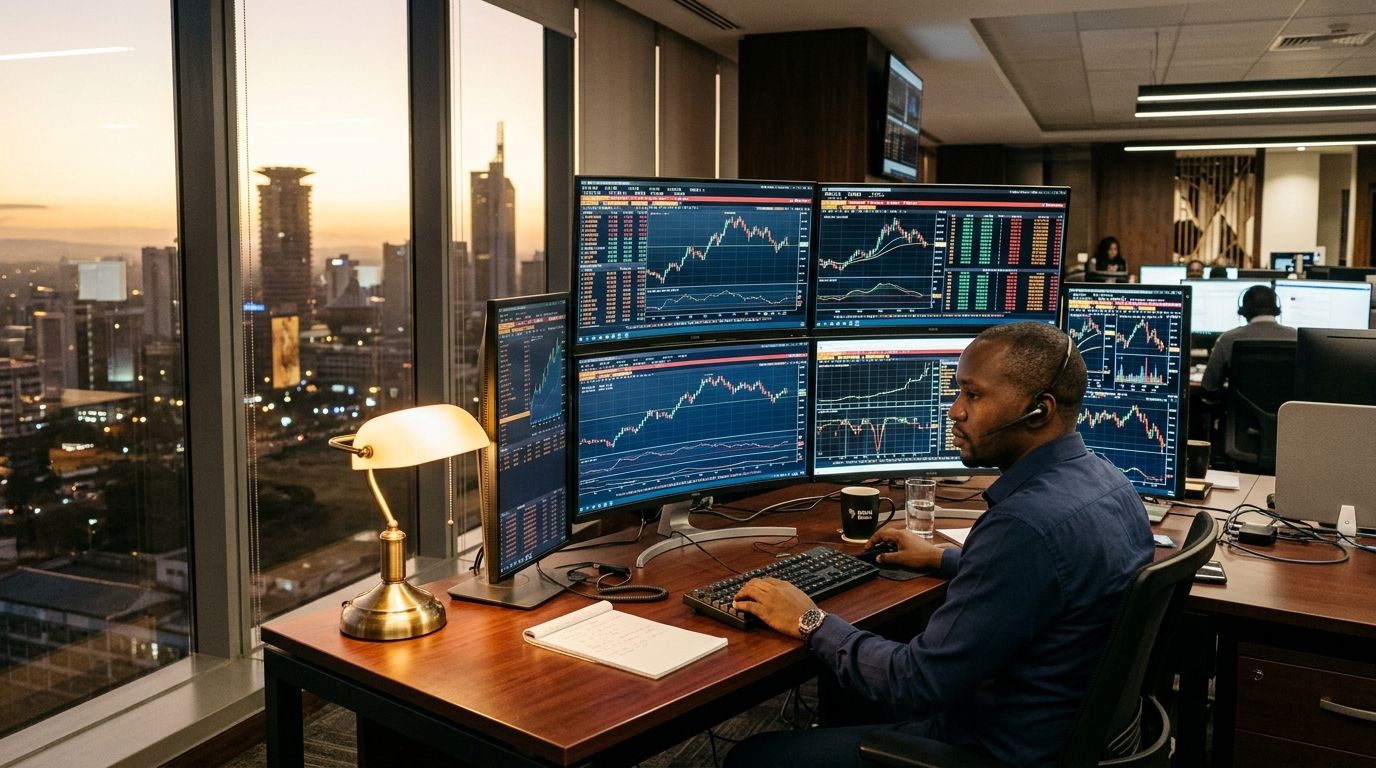
Figure 1: Institutional trading workstation in Nairobi during the pre-dawn Asian session (5:00 AM EAT), capturing early consolidation patterns across USD/JPY and cross pairs.
Chronological Progression Across the Pacific & Asia (Kenya Time)
The global trading day commences in the Pacific and moves westward through the financial capitals of the Asia-Pacific region:
Wellington (New Zealand): Opens at 10:00 PM EAT (during southern hemisphere summer) or 11:00 PM EAT (southern winter). Trading volume is relatively thin, generating the initial market prices after the weekend break.
Sydney (Australia): Opens at 12:00 AM (Midnight) EAT or 1:00 AM EAT. Liquidity broadens with the arrival of the Australian banking sector and corporate exporters.
Tokyo (Japan): The heavyweight of Asian finance officially commences core banking transactions at 9:00 AM JST, which corresponds exactly to 3:00 AM East Africa Time, closing at 6:00 PM JST (12:00 PM Midday EAT).
Singapore & Hong Kong: Asia's premier international forex liquidity routing hubs open one hour later at 4:00 AM EAT and close around 1:00 PM EAT.
Field Observation & Experience · Patrick Mahinge
During my years on the currency futures floor and later managing proprietary execution desks, the Asian session was consistently mischaracterized by novice retail traders as "dead time." In reality, institutional participants utilize Tokyo's controlled order book to build inventory, test structural price boundaries, and execute large corporate commercial adjustments without causing the violent slippage typical of London or New York opens. For a Kenyan retail trader, trading between 3:00 AM and 8:00 AM EAT offers a calmer, highly technical environment where price action respects chart geometry with exceptional fidelity.
2. Market Microstructure: BIS Data and the Liquidity Handoff
To understand Asian session liquidity, we must examine the hard figures published by the Bank for International Settlements (BIS) Triennial Central Bank Survey. The data confirms that Singapore (9.5%), Hong Kong (7.1%), and Tokyo (4.4%) collectively command over 21% of total global daily foreign exchange turnover—amounting to more than $1.6 trillion traded across Asian desks each trading day.
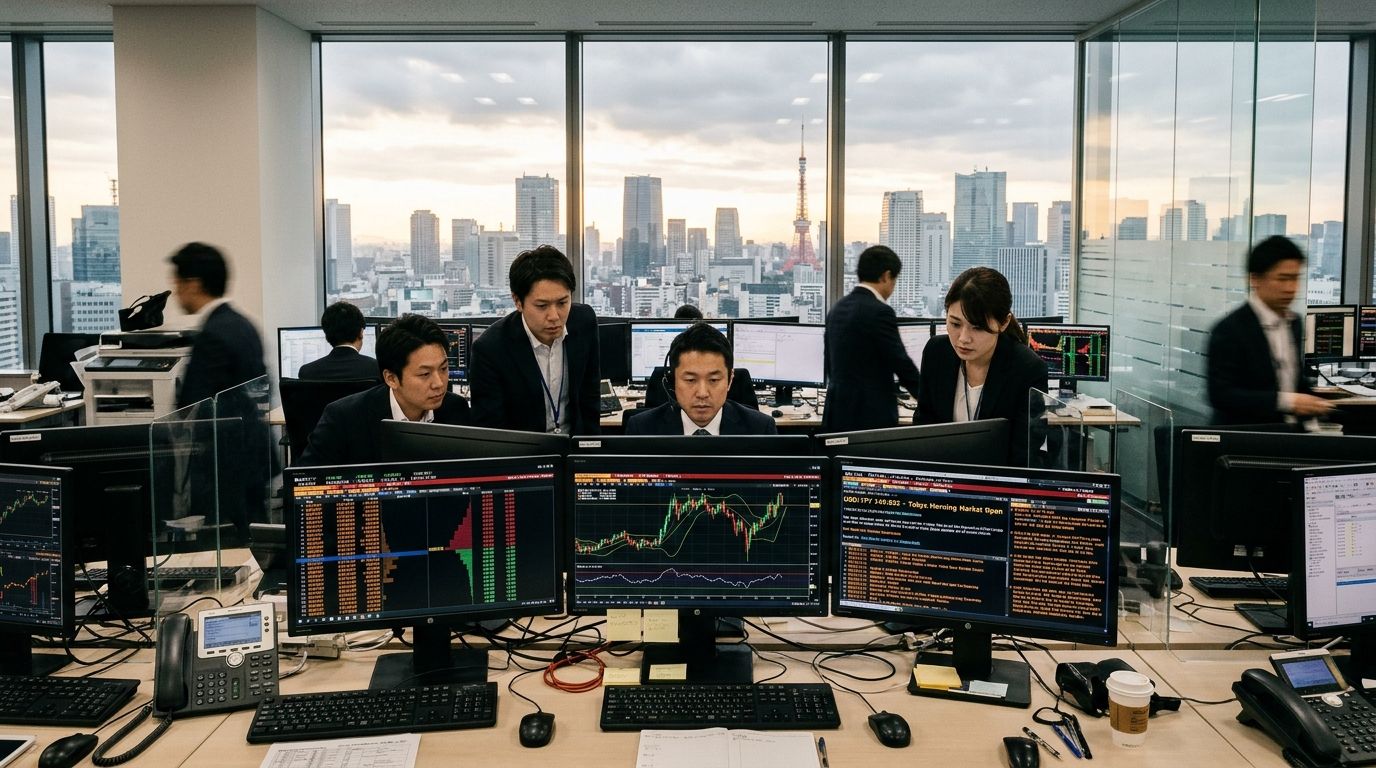
Figure 2: Dealing desks in Tokyo's Chuo-ku financial district executing commercial yen flow against the US dollar during early morning interbank operations.
The Anatomy of Intraday Volatility: Engle & Bollerslev Clustering
Econometric research into intraday exchange rate dynamics—originating from the seminal ARCH/GARCH volatility clustering models pioneered by Robert Engle and Tim Bollerslev—demonstrates that foreign exchange volatility follows an asymmetric U-shaped curve throughout the 24-hour cycle.
In Kenya time (EAT), this manifest as three distinct volatility phases:
Phase 1: Midnight Rollover Illiquidity (12:00 AM to 2:30 AM EAT): During this window, New York has closed, European desks are dormant, and Tokyo has not yet arrived. Interbank spreads on pairs like EUR/USD or GBP/USD can artificially widen by 2 to 5 pips due to bank settlement rollover charges. Rule of thumb: Avoid market orders during this phase.
Phase 2: Asian Price Discovery & Range Squeeze (3:00 AM to 8:30 AM EAT): Tokyo, Hong Kong, and Singapore banks inject fresh interbank liquidity. Spreads tighten back to base levels (0.2 to 0.8 pips on ECN accounts). Volatility is stable, with the average 15-minute range on USD/JPY hovering around 8 to 14 pips.
Phase 3: The Asian-European Golden Overlap (9:00 AM to 12:00 PM EAT): Frankfurt opens at 9:00 AM EAT (winter) or 10:00 AM EAT, followed by the London Stock Exchange open at 10:00 AM EAT or 11:00 AM EAT. Tokyo traders wrap up afternoon positions while European institutional money enters the market. This overlap generates significant breakout velocity.
The three windows that matter for Kenyan traders
Not every hour of the Asian session is equal. Based on liquidity patterns I have tracked across several years of Nairobi-based trading sessions, I divide the session into three windows.
03:00 to 06:00 EAT
Tokyo open
Japanese banks and importers begin trading. USD/JPY and EUR/JPY see the first flows of the day. This is the cleanest window for yen pairs.
06:00 to 10:00 EAT
Sydney and Tokyo overlap
The deepest part of the Asian session. AUD/JPY and AUD/USD are typically most active, and spreads on major pairs tend to be tightest.
10:00 to 12:00 EAT
Tokyo lunch and wind-down
Volume fades as Tokyo winds down. Price often ranges or reverses. Many experienced traders close positions or step away here.
3. The Tokyo Fixing (Teine / 中値) and Gotobi Day Mechanics
If there is one single institutional event every Kenyan trader must calendar, it is the Tokyo Fixing (known in Japan as Nakane or 中値). Occurring at precisely 9:55 AM Tokyo Time (3:55 AM East Africa Time in Kenya), this is the benchmark rate at which Japanese commercial banks, multi-national trading houses (like Mitsubishi, Mitsui, and Sumitomo), and import/export conglomerates settle foreign exchange obligations.
The "Gotobi" Day Factor (五日節)
In Japanese business practice, commercial settlement dates traditionally fall on days of the month ending in 5 or 0: the 5th, 10th, 15th, 20th, 25th, and 30th (known as Gotobi days). If any of these dates fall on a weekend, the settlement moves to the preceding Friday.
Academic studies by economists Takatoshi Ito and Yuko Hashimoto on Tokyo fixing microstructure confirm that on Gotobi days, Japanese commercial importers experience a persistent structural demand for US Dollars to pay for imported raw commodities, petroleum, and foreign goods. As a result, USD/JPY displays a statistically significant upward drift between 9:00 AM JST (3:00 AM EAT) and 9:55 AM JST (3:55 AM EAT).
Patrick's Tested Playbook: The Gotobi Tokyo Fixing Drift
I have traded this anomaly extensively using live ECN accounts funded through Kenya's local payment rails. The setup is remarkably straightforward: On Gotobi mornings at 3:15 AM EAT, monitor the 5-minute chart of USD/JPY. If price holds above the volume-weighted average price (VWAP) and Tokyo interbank depth is net-bid, institutional algorithmic buying typically carries the pair toward resistance ahead of 3:55 AM EAT. Once the 9:55 AM JST clock strikes, buying immediately dries up, frequently offering a clean mean-reversion short trade back to the session open.
4. Filterable Comparison: Best Currency Pairs for Kenyan Asian Hours
Not all currency pairs behave equally between 3:00 AM and 12:00 PM EAT. Trading European crosses like EUR/GBP or GBP/CHF during pure Tokyo hours is generally inefficient due to wider spreads and negligible volatility. Instead, focus capital on JPY crosses and Asian-Pacific commodity currencies.
Currency Pair
Type
Typical Spread (Pips)
Avg. Asian Range
Volatility Profile
Best Execution Window (EAT)
Optimal Strategy
USD/JPY
JPY Major
0.4 - 0.8
28 - 42 pips
Moderate
03:00 AM - 04:30 AM
Tokyo Fixing Drift / Range Scalping
AUD/JPY
Cross / Commodity
0.9 - 1.4
35 - 55 pips
High
03:30 AM - 06:30 AM
RBA Releases & China PMI Breakouts
AUD/USD
Commodity Major
0.6 - 1.0
25 - 38 pips
Moderate
04:00 AM - 07:00 AM
Support/Resistance Range Fade
NZD/USD
Commodity Major
0.8 - 1.3
24 - 35 pips
Low-Med
03:00 AM - 06:00 AM
RBNZ Cash Rate Announcement Trades
EUR/JPY
Cross
0.8 - 1.5
38 - 60 pips
High
09:00 AM - 12:00 PM
Asian Box Range Breakout (Frankfurt Open)
GBP/JPY
Cross ("The Dragon")
1.2 - 2.2
45 - 85 pips
Very High
09:30 AM - 12:00 PM
London Handover Breakout Expansion
NZD/JPY
Cross / Commodity
1.1 - 1.8
30 - 48 pips
Moderate
03:00 AM - 05:30 AM
Asian Mean Reversion Bands
EUR/USD
Global Major
0.2 - 0.5
18 - 28 pips
Low (Consolidation)
09:00 AM - 12:00 PM
Wait for European Liquidity Entry
5. Tested Strategies: Asian Range Box & Pre-Dawn Mean Reversion
Kenyan traders who thrive during Asian hours rely on two core, rule-based setups that exploit the statistical boundaries of low-volatility consolidation.
Strategy A: The Asian Range Box (London Open Handover)
This setup is widely regarded as one of the highest expectancy strategies available to East African retail traders. Because Tokyo establishes a clean, contained range, institutional dealers in London frequently target the liquidity pooled immediately above the Asian High and below the Asian Low.
Establish the Range Box: Mark the absolute highest price and lowest price between 3:00 AM EAT and 8:45 AM EAT on GBP/JPY, EUR/JPY, or USD/JPY.
Verify the Squeeze: The total range should ideally be under 45 pips. Tight ranges indicate volatility compression ready for expansion.
Identify the Manipulation Phase: Around 9:00 AM to 9:30 AM EAT (Frankfurt open), price frequently creates a fake break outside the box to trigger retail stop-loss orders.
Execute the True Breakout: Once London officially opens at 10:00 AM EAT, enter in the direction of the confirmed momentum candle that closes outside the Asian Box with high relative volume. Set stop loss at the midpoint of the Asian range.
Strategy B: Pre-Dawn Mean Reversion (Bollinger Squeeze Fade)
For Nairobi traders executing between 5:00 AM and 7:30 AM EAT before commuting, mean reversion on AUD/USD and USD/JPY provides reliable, bite-sized profits.
Indicator Setup: 15-minute chart with 20-period Bollinger Bands (2.0 Standard Deviations) and 14-period RSI.
Entry Criteria: Look for a touch or pierce of the outer Bollinger Band accompanied by an RSI divergence (RSI > 70 for short; RSI < 30 for long).
Target: The 20-period exponential moving average (center band). Typical take profit is 10 to 18 pips with a tight 8-pip stop loss.
6. Interactive Asian Range Breakout Calculator
Use this calculation tool to input your observed Asian session High and Low between 3:00 AM and 8:45 AM EAT to generate exact entry breakout triggers, stop losses, and multi-tier take profit targets.
Asian Range Pip Calculator (Vanilla JS)
Calculate London open breakout levels based on Tokyo high-low parameters.
Range Size33.0 Pips
Bullish Breakout Entry152.480
Bearish Breakdown Entry152.090
Take Profit 1 (1.5x)152.975
Box Midpoint (Stop Loss)152.285
7. CMA-Regulated Broker Benchmarks in Kenya
Under the Capital Markets (Online Foreign Exchange Trading) Regulations 2017, the Capital Markets Authority (CMA) of Kenya mandates stringent capital reserves, client fund segregation in Kenyan commercial banks, and regular audit reporting.
To evaluate broker claims, I placed my own funds on the line across four licensed Kenyan non-dealing online forex brokers. Each account was funded using Safaricom M-Pesa to measure deposit latency, Asian session overnight spreads, and execution slippage during the 3:55 AM EAT Tokyo fix.
Infrastructure Tip: Latency from Nairobi to Interbank Matching Engines
Kenyan broadband fiber (such as Safaricom Home Fibre, Zuku, or Airtel 5G) typically achieves 140ms to 180ms ping to London data centers (Equinix LD4) and approximately 210ms to 240ms to Tokyo (Equinix TY3). While this is more than sufficient for manual day trading and swing trading, traders running automated high-frequency news algorithms on the Tokyo fix should deploy a low-latency Virtual Private Server (VPS) located in London or Tokyo.
8. The Kenyan Trader's Lifestyle: Balancing Asian Hours With Daily Routine
One of the primary reasons forex trading has surged in popularity across Nairobi, Nakuru, and Eldoret is how cleanly the Asian session fits into a working professional's schedule.
The "5:00 AM Club" Trading Routine
04:45 AM EAT: Wake up, prepare coffee, check the economic calendar on Kenya Forex Firm for surprise Australian (RBA) or Chinese macroeconomic releases (Caixin Manufacturing PMI).
05:15 AM EAT: Screen USD/JPY, AUD/JPY, and AUD/USD for Bollinger Band compression or Tokyo fixing exhaustion. Set limit orders with pre-defined take profit and stop loss targets.
07:30 AM EAT: Manage or close open intraday positions before departing for the morning commute into Westlands, Upper Hill, or Nairobi CBD.
09:00 AM - 10:00 AM EAT: For traders with mobile access or remote work flexibility, observe the Frankfurt and London opens for Asian Range Box breakout confirmations.
9. Frequently Asked Questions (FAQ)
In Kenya (East Africa Time, UTC+3), the core Tokyo Asian session officially operates from 3:00 AM to 12:00 PM (Midday) EAT. Sydney initiates the broader Asia-Pacific liquidity window starting around 12:00 AM (Midnight) EAT, while Singapore and Hong Kong open at 4:00 AM EAT.
No. Kenya operates permanently on UTC+3 and Japan operates permanently on UTC+9. Neither country observes Daylight Saving Time (DST). Consequently, Tokyo is always exactly 6 hours ahead of Kenya all 365 days of the year.
This period marks the interbank daily rollover window. The New York session has closed, European banks are shut, and Tokyo dealers have not yet commenced trading. With minimal counterparty liquidity, liquidity providers widen bid-ask spreads and rollover swap fees are credited or debited to retail accounts.
The Tokyo Fixing occurs at 9:55 AM JST, which is 3:55 AM East Africa Time (EAT) in Kenya. It is the moment Japanese financial institutions fix their daily commercial customer rates. On Gotobi days (dates ending in 5 or 0), substantial corporate demand for USD often causes predictable price momentum on USD/JPY leading into 3:55 AM EAT.
Yes. Online forex trading is 100% legal in Kenya under the oversight of the Capital Markets Authority (CMA). Licensed non-dealing online forex brokers operate 24 hours a day from Monday morning to Saturday morning, fully enabling Kenyan traders to participate in the Asian session.
Yes. CMA-regulated forex brokers like Pepperstone Kenya, FXPesa, and HF Markets have direct automated API integrations with Safaricom M-Pesa. Deposits made at 3:00 AM reflect in your trading account within seconds, allowing immediate execution on Tokyo opens.
Wait! Take Patrick's Asian Session Nairobi Playbook
Before you close this page, grab the free 2027 Tokyo Breakout & Gotobi Fixing calendar tailored specifically for Kenyan time (EAT). Includes M-Pesa broker fee checklists.