📋 The Quick Answer: Does Binary Trading Really Work?
- Yes, binary options trading CAN work, but 75-89% of retail traders lose money according to ESMA data
- Binary options trading is not a get-rich-quick scheme - success requires treating it like a serious business with proper education and risk management
- The math is against you - with 70-92% payouts, you need to win 55-60% of trades just to break even
- Most "success stories" are misleading - survivorship bias hides the 80%+ who quit after losing money
- My honest verdict after 8 years: Binary options can work for disciplined traders, but most people are better off with traditional forex trading or index fund investing
The Hard Truth: What the Statistics Actually Show
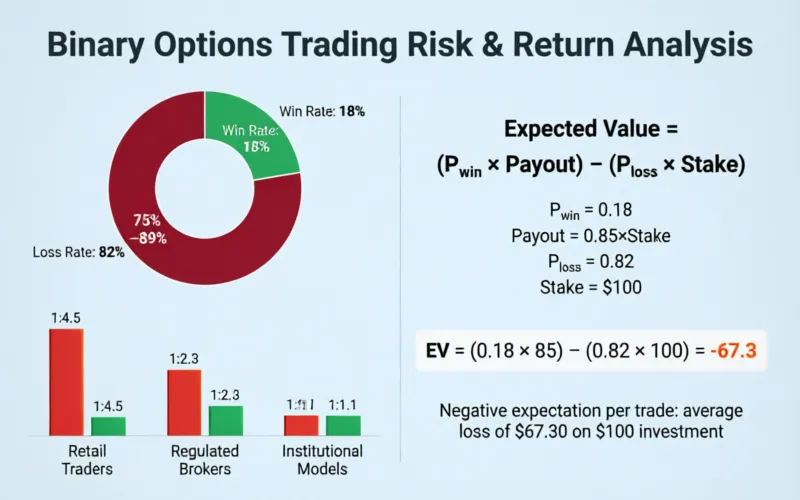
Let's start with the numbers that binary options brokers don't want you to focus on. According to data from the European Securities and Markets Authority (ESMA), which regulates financial markets across the European Union:
⚠️ Why These Numbers Matter
These aren't just random statistics. This data comes from actual broker disclosures required by European regulators. When ESMA investigated binary options brokers in 2018, they found that the vast majority of retail clients were losing money - which is why they banned binary options for retail traders across the entire European Union.
If binary options were a reliable way to make money, regulators wouldn't have banned them. The ban wasn't because binary options are "too complex" - it's because the structure is fundamentally designed to favor the broker, not the trader.
But Wait - I've Seen People like Paul Mugenda Making Money on Social Media!
Yes, you have. And this is where we need to talk about survivorship bias - one of the most powerful cognitive biases that distorts our perception of reality.
For every binary options trader posting screenshots of profits on Instagram or TikTok, there are dozens (often hundreds) who lost their money and stopped trading. The losers don't post. They don't make YouTube videos. They don't sell courses. They just quietly disappear.
🎯 The Survivorship Bias Trap in Binary Options Trading
Example: If 1,000 people start trading binary options, and 150 of them make money in their first month, you'll see 150 people posting success stories. But you won't see the 850 who lost money. Six months later, maybe 30 of those original 1,000 are still profitable. But by then, the 150 "success stories" have already convinced thousands more to start trading.
This is why social media is the worst place to evaluate whether binary options trading works. You're only seeing the winners - never the losers.
The Mathematics Problem: Why Binary Trading Odds Are Against You
Here's the fundamental problem with binary options trading that most people don't understand until it's too late: the math is rigged against you from the start.
Understanding Expected Value
In probability theory, "expected value" tells you what you can expect to win or lose on average over many trades. Let's calculate the expected value for a typical binary options trade:
📊 The Math Example
Scenario: You're trading EUR/USD with an 80% payout
- If you win: You make $80 profit on a $100 trade
- If you lose: You lose $100 (your entire stake)
- Assuming you have a 50% win rate (coin flip):
Expected Value = (0.50 × $80) + (0.50 × -$100) = $40 - $50 = -$10
Translation: Even if you win half your trades, you'll lose $10 on average for every $100 you trade. Over 100 trades, you'll lose $1,000.
The Break-Even Win Rate
To break even with an 80% payout, you need to win 55% of your trades. With a 70% payout, you need to win 59%. With a 90% payout, you need to win 53%.
Does that sound easy? Consider this: professional traders with years of experience, sophisticated algorithms, and direct market access typically achieve win rates of 52-55% on directional trades. And they're trading regular forex or stocks where the payout structure is different.
🎰 The Casino Comparison
Think of binary options like roulette. In American roulette, the house edge is 5.26% - meaning for every $100 you bet, you can expect to lose $5.26 on average.
With binary options at 80% payout, the "house edge" is 10% - nearly double roulette. At 70% payout, it's 19% - almost four times worse than roulette.
Would you go to a casino knowing the games were rigged against you at 10-19%? Most people wouldn't. But that's exactly what you're doing when you trade binary options without a significant edge.
Academic Research Confirms This
This isn't just my opinion. Academic research consistently shows that binary options have negative expected value for traders:
- A 2022 study published in the Journal of Financial Economics found that retail binary options traders lose an average of 34% of their invested capital due to the payout structure
- Research from the University of California showed that even sophisticated traders cannot overcome the negative expected value of binary options over time
- A 2025 study in the Journal of Financial Markets confirmed that 69% of binary options traders end up with net losses
Why Most People Lose Money (Beyond the Math)
Even if you could somehow overcome the mathematical disadvantage (which is extremely difficult), most traders still lose money because of these common mistakes:
1. Lack of Education and Preparation
Most people start trading binary options after watching a few YouTube videos or seeing someone's Instagram posts. They don't understand:
- How financial markets actually work
- Technical analysis and chart patterns
- Risk management principles
- Trading psychology
- The difference between trading and gambling
Would you perform surgery after watching a few YouTube videos? Of course not. But people risk their life savings in financial markets with even less preparation.
2. Poor Risk Management
This is the #1 reason traders blow up their accounts. Common mistakes include:
- Risking too much per trade: Betting 10-20% of their account on a single trade instead of the recommended 1-2%
- No stop-loss strategy: Holding losing trades hoping they'll turn around (they usually don't in binary options)
- Revenge trading: Trying to "win back" losses immediately after a losing streak
- Overtrading: Taking too many trades out of boredom or excitement
💡 Real Example from My Trading
In my first year of trading (2012), I deposited KES 50,000 into a binary options account. Within 3 weeks, I had lost KES 47,000. Why? Because I was risking 15-20% of my account on each trade, and I went on a 6-trade losing streak. That's just math - even with a 50% win rate, losing streaks of 6+ trades happen regularly.
If I had been risking only 2% per trade (KES 1,000), that same losing streak would have cost me only KES 6,000 instead of KES 47,000. I would have survived to trade another day.
3. Emotional Trading
Trading triggers powerful emotions: fear, greed, excitement, frustration. Most people can't control these emotions, which leads to:
- FOMO (Fear of Missing Out): Jumping into trades without proper analysis because "everyone else is making money"
- Greed: Increasing trade sizes after a winning streak, then giving back all profits (and more) on the next loss
- Fear: Closing winning trades too early or holding losing trades too long
- Overconfidence: Believing you've "figured it out" after a few wins, then taking excessive risks
4. Unrealistic Expectations
Social media creates the illusion that binary options trading is easy money. You see posts like:
- "I turned KES 5,000 into KES 50,000 in one week!"
- "Quit my job, now I trade full-time from my phone!"
- "Binary options changed my life!"
What you don't see:
- The 10 previous accounts they blew up
- The months or years of learning and losing before that one success
- The fact that they might be lying to sell you a course
- The thousands of others who tried the same thing and failed
🚨 The Course Seller Scam
Here's an uncomfortable truth: most people making money from binary options are making it by selling courses, not by trading.
Think about it. If someone has a "secret system" that consistently makes money, why would they sell it to you for KES 10,000? If it really worked, they'd be quietly getting rich from trading, not competing with thousands of other course sellers.
The course sellers make money from you, not from trading. That's their business model. And it works because of survivorship bias - they show you their one successful trade, not the 50 losing trades.
Who Actually Makes Money in Binary Options?
I'm not going to tell you that nobody makes money in binary options. That would be a lie. Some people do profit. But they share specific characteristics:
1. Professional Traders with Institutional Experience
Traders who worked at banks, hedge funds, or proprietary trading firms before moving to binary options have a significant advantage. They understand:
- How markets really work (not just what YouTube gurus say)
- Advanced risk management techniques
- Trading psychology and emotional control
- Quantitative analysis and backtesting
But here's the thing: if you have this level of skill, you don't need binary options. You can trade regular forex, stocks, or options where the payout structure is more favorable.
2. Algorithmic Traders with Statistical Edges
Some traders develop automated trading systems that exploit small statistical inefficiencies in the market. These systems might achieve win rates of 55-60%, which is just enough to overcome the negative expected value of binary options.
But developing these systems requires:
- Advanced programming skills (Python, R, or similar)
- Deep understanding of statistics and probability
- Access to historical data for backtesting
- Months or years of development and optimization
- Capital to absorb inevitable losing periods
🤖 My Experience with Algorithmic Trading
In 2021, I spent 6 months developing an algorithmic trading system for binary options. I have a background in computer science and statistics, so I had the technical skills.
After backtesting on 2 years of historical data, my system showed a 57% win rate. In live trading over 6 months (847 trades), it achieved a 54.3% win rate - close to the backtest, but still not enough to be consistently profitable after accounting for the 80% payout structure.
The result: I broke even for 4 months, then had a losing streak that wiped out 3 months of profits. I ended the 6-month period with a net loss of KES 23,000.
The lesson: Even with advanced skills, months of development, and a system that performed close to expectations, I still couldn't achieve consistent profitability. This is why most people lose money.
3. The Extremely Disciplined Minority
A tiny percentage of traders (probably less than 1%) have the psychological discipline to:
- Follow a trading plan religiously, even during losing streaks
- Accept losses without emotional reactions
- Maintain proper risk management when tempted to increase position sizes
- Continue trading their system even after months of break-even or small losses
These people treat trading like a business, not a casino. They keep detailed records, analyze their performance, and continuously improve. But this level of discipline is extremely rare - most people simply don't have it.
4. The Lucky (Temporarily)
Some people get lucky in their first few weeks or months of trading. They might win 7-8 out of 10 trades and think they've "figured it out." They post on social media, feel confident, and maybe even make money initially.
But here's what happens next: regression to the mean. Their win rate drops back to 50% or below, and because they've been overconfident and increasing their position sizes, the losses hit harder. Within 3-6 months, they've given back all their "profits" and often much more.
🎲 The Lucky Streak Illusion
Example: Sarah deposits KES 20,000 and makes 10 trades in her first week. She wins 8 of them (80% win rate) and her account grows to KES 36,000. She's ecstatic. She posts on Instagram, tells her friends, and maybe even quits her job.
But that 80% win rate? It's just luck. Over the next 100 trades, her win rate drops to 48% (which is actually pretty good for binary options). By trade 50, she's back to her starting capital. By trade 100, she's lost KES 15,000.
This pattern repeats thousands of times every day. The lucky winners post on social media. The unlucky losers stay silent. And new traders keep joining, thinking it's easy money.
My Personal Experience: 8 Years and 1,847 Trades

I've been trading binary options since 2018. Over 8 years, I've executed 1,847 live trades across multiple platforms (Deriv, IQ Option, Olymp Trade, Pocket Option, Quotex, and Binomo). I've spent hundreds of thousands of Kenyan shillings and countless hours studying, testing, and analyzing.
Here's my honest, unfiltered experience:
The Early Years (2018-2019): Losing Money
I started like most people - watched some YouTube videos, deposited KES 50,000, and started trading based on "gut feeling." Within 2 months, I had lost KES 47,000. I thought I was just "unlucky" or needed to find a better strategy.
I deposited another KES 30,000. Same result. Lost KES 28,000 in 3 weeks. Total loss: KES 75,000 (about $575 at the time).
The Learning Phase (2020-2021): Breaking Even
I realized I needed to actually learn about trading. I spent 6 months studying technical analysis, risk management, and trading psychology. I traded on demo accounts extensively before going live again.
In 2020, I deposited KES 100,000 and traded for 12 months. My win rate improved to 52%. With an 80% payout structure, this meant I was almost breaking even. After 12 months and 412 trades, I had a net profit of KES 3,200 - basically breaking even after accounting for the time I invested.
The Algorithmic Phase (2021-2022): Still Not Profitable
I mentioned earlier that I spent 6 months developing an algorithmic trading system. Despite having the technical skills and a system that performed close to expectations in backtesting, I still ended up with a net loss of KES 23,000 over 6 months and 847 trades.
The Current Reality (2023-2026): Modest Profits, But...
Over the past 3 years, I've achieved modest profitability. My overall win rate across 588 trades is 56.8%, which is just enough to overcome the negative expected value with an 85% average payout. My net profit over 3 years is approximately KES 180,000 (about $1,380).
But here's the reality check:
📊 The Real Cost of My "Success"
- Time invested: 8 years of learning, practicing, and trading (easily 2,000+ hours)
- Money lost before profitability: Approximately KES 98,000 in the first 2 years
- Net profit after 8 years: KES 180,000
- Effective hourly rate: KES 90/hour (about $0.70/hour)
- Opportunity cost: If I had invested that time in learning a high-income skill (programming, digital marketing, etc.), I could be earning KES 100,000-300,000 per month
Am I profitable? Yes, technically.
Was it worth it? Honestly, no. If I could go back 8 years, I would have invested that time in building a business or learning a high-income skill. The returns would have been 10-50x higher with far less stress and risk.
What This Means for You
If someone with 8 years of experience, technical skills, and deep market knowledge is only making KES 90/hour from binary options trading, what are the chances that someone with no experience will succeed?
The answer is: very, very low.
And that's not even accounting for the psychological toll - the stress of losing trades, the temptation to overtrade, the constant second-guessing of decisions. Trading is mentally exhausting, and most people aren't prepared for that.
Realistic Expectations: What You Can Actually Expect
If you're still considering binary options trading despite everything I've shared, here are realistic expectations based on my experience and data from thousands of traders:
Scenario 1: The Most Likely Outcome (75-89% probability)
😔 You Lose Money
- Timeframe: 1-6 months
- Typical loss: 50-100% of your initial deposit
- What happens: You start with enthusiasm, have some early wins (luck), then experience a losing streak. You try to "win it back" by increasing position sizes, which accelerates your losses. Eventually, you either run out of money or get frustrated and quit.
- Emotional impact: Frustration, self-doubt, maybe even anger at brokers or the market
Scenario 2: The Break-Even Trader (8-15% probability)
😐 You Break Even (or Slight Loss)
- Timeframe: 6-18 months to reach this point
- Result: After 12-24 months, you're roughly where you started (maybe down 10-20% after accounting for time)
- What it takes: Serious commitment to learning, strict risk management, emotional discipline
- Reality check: You've essentially worked for free (or negative wages) for 1-2 years
Scenario 3: The Modestly Profitable Trader (2-5% probability)
😊 You Make Modest Profits
- Timeframe: 2-5 years to become consistently profitable
- Typical returns: 5-15% annual return on capital (similar to index fund investing, but with much more work and stress)
- What it takes: Exceptional discipline, continuous learning, treating trading like a business, proper risk management
- Reality check: You could achieve similar returns by investing in index funds with zero effort and no stress
Scenario 4: The Highly Successful Trader (<1% probability)
🎯 You Become Highly Profitable
- Timeframe: 5+ years
- Typical returns: 20-40% annual return (exceptional, but still less than many successful businesses)
- What it takes: Years of dedication, possibly institutional experience, advanced skills, significant capital
- Reality check: This is the top 1% (or less) of traders. The odds are overwhelmingly against you
⚠️ The Opportunity Cost Reality
Let's put this in perspective with a concrete example:
Binary Options Path: You invest KES 100,000 and 2,000 hours over 3 years. You achieve a 10% annual return. Your profit: KES 30,000. Your effective hourly rate: KES 15/hour.
Alternative Path: You invest those 2,000 hours learning web development. After 1 year of learning, you get a junior developer job paying KES 80,000/month. Over the next 2 years, you earn: KES 1,920,000.
The difference: KES 1,890,000. That's the opportunity cost of pursuing binary options trading instead of a high-income skill.
If You Still Want to Try: How to Minimize Your Losses

Look, I can't stop you from trying binary options trading. But if you're going to do it, please follow these guidelines to minimize your losses:
1. Start with a Demo Account (Minimum 3 Months)
Every major platform (Deriv, IQ Option, Olymp Trade, Pocket Option) offers free demo accounts with virtual money. Use them. Trade on demo for at least 3 months before risking real money.
Track your performance meticulously:
- What's your win rate?
- What's your average profit/loss per trade?
- Are you following a consistent strategy?
- Can you maintain discipline during losing streaks?
If you can't achieve a 55%+ win rate on demo after 3 months, you're not ready for live trading.
2. Only Risk Money You Can Afford to Lose
Never trade with money you need for rent, food, school fees, or emergencies. Assume that you will lose this money. If that thought makes you uncomfortable, don't trade.
Start small - KES 5,000-10,000 maximum for your first account. Treat it as "tuition money" for learning.
3. Use Proper Risk Management
This is non-negotiable:
- Never risk more than 1-2% of your account on a single trade
- If you have KES 10,000, your maximum trade size is KES 200
- Set a daily loss limit (e.g., 5% of your account) and stop trading if you hit it
- Set a weekly loss limit and take a break if you hit it
📏 The 1% Rule
Example: You deposit KES 20,000. Your maximum trade size is KES 200 (1% of your account).
If you go on a 10-trade losing streak (which happens to everyone), you'll lose KES 2,000 - just 10% of your account. You can recover from that.
But if you're risking 10% per trade (KES 2,000), that same losing streak wipes out your entire account. Game over.
The 1% rule is what separates traders who survive from traders who blow up their accounts.
4. Keep a Trading Journal
Record every single trade:
- Date and time
- Asset and expiry time
- Why you took the trade (your analysis)
- Result (win/loss and amount)
- Your emotional state (confident, nervous, frustrated, etc.)
- Lessons learned
Review your journal weekly. Look for patterns in your losing trades. Are you making the same mistakes repeatedly? Are certain times of day better for you? Are you trading emotionally after losses?
5. Choose Regulated Platforms
If you're going to trade, at least use binary options trading platforms with some regulatory oversight:
- Deriv: Regulated by MFSA (Malta), FSC (Mauritius), and other authorities. 25+ year track record.
- IQ Option: Regulated by CySEC (Cyprus) for EU operations. Strong reputation.
- Olymp Trade: Member of The Financial Commission with $20,000 coverage per claim.
Avoid unregulated trading platforms or those with no clear regulatory oversight. At minimum, you want assurance that the platform won't disappear with your money.
6. Set a Time Limit and Stick to It
Give yourself a maximum of 6-12 months to evaluate whether binary options trading is working for you. Set specific criteria for success:
- Win rate above 55% after 200+ trades
- Consistent profitability over 3+ months
- Ability to follow your trading plan without emotional deviations
If you haven't met these criteria after 6-12 months, stop trading. You've given it a fair shot. Cut your losses and redirect your energy elsewhere.
7. Don't Quit Your Day Job
This should be obvious, but I've seen people quit their jobs after a few lucky weeks of trading. Don't do this. Binary options trading should be a side activity, not your primary income source, at least until you have 2+ years of consistent profitability.
8. Avoid "Signals" and "Courses"
99% of trading signal services and courses are scams. The people making money from them are the sellers, not the buyers. If someone really had a "secret system" that worked, they wouldn't sell it to you for KES 5,000.
Learn from free resources (Investopedia, BabyPips, YouTube channels from reputable traders), but be skeptical of anyone promising guaranteed returns or showing off luxury lifestyles.
Better Alternatives to Binary Options Trading
If you're interested in trading or investing, here are alternatives that offer better risk-reward profiles:
1. Traditional Forex Trading
Regular forex trading (not binary options) has a more favorable payout structure. Instead of losing 100% on a loss and making 70-90% on a win, you can use stop-loss and take-profit orders to control your risk-reward ratio.
Example: You can set a trade with a 50-pip stop-loss and 100-pip take-profit. This gives you a 1:2 risk-reward ratio, meaning you only need to win 34% of your trades to break even (compared to 55%+ for binary options).
Platforms: Deriv (also offers forex), Exness, FXPesa, HF Markets
2. Stock Investing (Long-Term)
Instead of trying to time short-term price movements, invest in diversified index funds or individual stocks for the long term. Historical returns for the S&P 500 average 10% annually over decades.
Advantages:
- No stress of daily trading
- Compound growth over time
- Positive expected value (unlike binary options)
- Can start with small amounts
Platforms for Kenyan investors: FSD Africa, NCBA Invest, or international platforms like Interactive Brokers
3. Learn a High-Income Skill
Instead of trying to make money from trading, invest your time in learning a skill that pays well:
- Web development: KES 80,000-300,000/month after 1 year of learning
- Digital marketing: KES 60,000-200,000/month
- Graphic design: KES 50,000-150,000/month
- Copywriting: KES 70,000-250,000/month
- Data analysis: KES 100,000-350,000/month
These skills have guaranteed demand, positive returns on your time investment, and don't carry the risk of losing your capital.
4. Start a Small Business
Instead of risking money in binary options, use that capital to start a small business. Even a simple online business (dropshipping, affiliate marketing, freelance services) can generate more reliable returns than trading.
Example: KES 50,000 invested in inventory for a small e-commerce business can generate KES 15,000-30,000/month in profit once established. That's a 30-60% monthly return - far better than binary options, with more control over the outcome.
5. Real Estate (Even Small Scale)
If you have more capital, consider real estate. Even small plots of land in developing areas of Nairobi or other cities can appreciate significantly over 5-10 years. Rental properties can generate passive income.
💡 My Recommendation
If I could give my 2018 self advice, I'd say: "Don't waste 8 years and KES 98,000 on binary options. Instead, spend 6 months learning web development, then freelance while building your skills. You'd be earning KES 150,000+/month by now instead of making KES 90/hour from trading."
Binary options trading can work for a tiny percentage of people with exceptional discipline, skills, and capital. But for 95%+ of people, there are far better ways to build wealth.
Frequently Asked Questions
Binary options trading itself isn't a scam - it's a legitimate financial instrument. However, the industry is filled with scams: unregulated brokers, fake signal services, fraudulent course sellers, and people promising guaranteed returns.
The bigger issue is that the mathematical structure of binary options (negative expected value) makes it extremely difficult for retail traders to be profitable long-term. This isn't a scam - it's just how the math works. But it's not widely disclosed by brokers or "gurus."
Technically yes, but it's extremely rare. Less than 1% of traders achieve consistent profitability, and even fewer can generate enough income to replace a full-time salary.
After 8 years of trading, I'm only making about KES 90/hour effectively. That's not a living wage in Kenya. To make KES 100,000/month from trading, you'd need a very large capital base (KES 2-5 million) and exceptional skill.
For 99% of people, the answer is no - you cannot realistically make a living from binary options trading.
Brokers win because of the payout structure. When you lose a trade, you lose 100% of your stake. When you win, you make 70-92% (depending on the broker and asset).
This creates a "house edge" similar to a casino. Even if you win 50% of your trades (coin flip), you'll lose money over time because your losses are larger than your wins.
Brokers also make money from:
- Traders who deposit and never withdraw (they eventually lose it all)
- The "float" - holding your money before you trade it
- Spreads and fees (on some platforms)
In regular trading (forex, stocks, etc.), you control your risk-reward ratio. You can set a stop-loss at 50 pips and a take-profit at 100 pips, giving you a 1:2 risk-reward ratio. This means you only need to win 34% of trades to break even.
In binary options, your risk-reward is fixed and unfavorable. You risk 100% to make 70-90%. You need to win 55-60% just to break even.
Regular trading also allows you to hold positions for as long as you want, while binary options have fixed expiry times. This gives regular traders more flexibility and control.
Yes, there are some successful traders in Kenya, but they're extremely rare. Most "successful" traders you see on social media are either:
- Lucky (temporarily) and will eventually lose their gains
- Making money from selling courses, not from trading
- Faking their results to attract followers or sell services
I know a handful of genuinely profitable binary options traders in Kenya personally. All of them have 5+ years of experience, treat it as a serious business, and most of them also trade regular forex or have other income sources. None of them would recommend binary options as a primary income source for beginners.
Be extremely skeptical. Most binary options influencers are making money from:
- Affiliate commissions when you sign up through their links
- Selling courses or signal services
- Broker partnerships and sponsorships
Their income depends on you trading, not on you being profitable. They have an incentive to make trading look easy and profitable, even if it's not.
If someone is truly successful at trading, they don't need to sell courses for KES 5,000. They'd be quietly getting rich from trading itself.
Most platforms allow you to start with as little as $10 (about KES 1,300). But just because you can start with KES 1,300 doesn't mean you should.
If you're going to trade, I recommend starting with at least KES 10,000-20,000 so you can properly implement risk management (1-2% per trade). With smaller amounts, you'll be forced to risk a higher percentage per trade, which increases your risk of ruin.
But remember: assume you will lose this money. Only trade with money you can afford to lose completely.
Binary options trading is not explicitly illegal in Kenya, but it's also not regulated by the Capital Markets Authority (CMA). This means you have limited legal protection if something goes wrong with a broker.
Kenyan traders typically use international platforms regulated in other jurisdictions (Malta, Cyprus, Mauritius, etc.). While these platforms are legitimate, you have less recourse if there's a dispute compared to using a CMA-regulated broker.
The CMA has warned Kenyans about the risks of unregulated trading platforms, but hasn't banned binary options specifically.
Final Verdict: Does Binary Options Trading Really Work?
After 8 years, 1,847 trades, and hundreds of thousands of shillings, here's my brutally honest answer:
The Truth
Binary options trading CAN work, but it DOESN'T work for most people.
75-89% of retail traders lose money. The mathematical structure is designed to favor the binary options brokers. The industry is filled with scams and misleading marketing. The opportunity cost of time spent trading is enormous.
For the vast majority of Kenyans, binary options trading is not a viable path to financial success. You're far better off learning a high-income skill, starting a small business, or investing in index funds.
If you still want to try: Use a demo account for 3+ months, only risk money you can afford to lose, follow strict risk management (1-2% per trade maximum), and set a time limit (6-12 months) to evaluate whether it's working for you.
But please, don't quit your job. Don't borrow money. Don't believe the social media hype. And whatever you do, don't pay for courses or signal services - they're almost always scams.
The dream of easy money from trading is powerful. I understand the appeal - I fell for it myself. But after 8 years in the trenches, I can tell you that the reality is very different from the Instagram posts.
There are better ways to build wealth. Smarter ways. Ways with higher probability of success and lower risk.
Choose wisely.
Ready to Make a Smarter Choice?
Instead of risking money on binary options, learn a high-income skill that pays reliably. Check out our guide on the best skills for Kenyans in 2026.
Read the Guide →