
Key Takeaways for Kenyan Traders
- The forex market operates 24/5 in Kenya, opening at 1:00 AM EAT on Monday and closing at 1:00 AM EAT on Saturday.
- The London-New York overlap (4:00 PM - 8:00 PM EAT) is the single most profitable window, responsible for over 50% of daily forex volume.
- London dominates with 43% of global forex turnover (Bank for International Settlements, 2025 Triennial Survey), making EUR/USD, GBP/USD, and GBP/JPY the most liquid pairs during 11:00 AM - 8:00 PM EAT.
- Kenya does not observe DST, but London and New York do - expect a one-hour shift in session times between late March and early November.
- Best session for Kenyan day traders: 11:00 AM - 8:00 PM EAT (London) for trend-following, and 4:00 PM - 8:00 PM EAT (overlap) for breakout strategies.
- Avoid the 8:00 PM - 10:00 PM EAT "dead zone" where spreads widen and price action becomes choppy.
Why Kenya's Time Zone Is a Trader's Secret Weapon
As someone who has traded forex from Nairobi for over twelve years, I can tell you this with absolute conviction: Kenya's position on the East Africa Time (EAT, UTC+3) zone is one of the most advantageous geographic positions a retail forex trader can occupy. While traders in New York lose sleep chasing the London open, and traders in Tokyo sacrifice their evenings for the New York session, Kenyan traders enjoy the best of both worlds during regular waking hours.
Consider this: the two most important sessions in global forex - London and New York - run almost entirely during Kenya's daytime and early evening. According to the Bank for International Settlements' 2025 Triennial Central Bank Survey, London alone accounts for 43.1% of global forex turnover, while New York handles approximately 18.6%. Combined, these two sessions drive more than 60% of the world's $7.5 trillion daily forex volume. And for you, sitting in Nairobi, Mombasa, Kisumu, or Eldoret, these sessions happen while the sun is still up.
Between 11:00 AM and 8:00 PM EAT, you have access to 9 consecutive hours of peak global liquidity. This is the window where institutional order flow is thickest, spreads are tightest, and technical analysis works most reliably.
For traders balancing forex with a day job, university studies, or family responsibilities in Kenya, this is transformative. You can analyze charts during your lunch break, execute trades when you get home from work, and still have your evenings free. Compare this to a trader in Los Angeles who must wake at 3:00 AM to catch the London open, or a trader in Sydney who works through the night for New York volatility.
The Four Forex Trading Sessions in Kenyan Time
The forex market operates around the clock by following the sun across four major financial centers. Each session has its own personality, volatility profile, and ideal trading approach. Here is exactly when each session runs in East Africa Time.
Sydney Session
1:00 AM - 10:00 AM EATThe quietest session of the four. Sydney kicks off the trading week and sets the initial tone. Liquidity is thin, volatility is low, and spreads can widen slightly. Ideal for range traders and those preparing their weekly bias.
Tokyo Session
3:00 AM - 12:00 PM EATThe Asian session's anchor. Tokyo brings moderate liquidity with a focus on JPY, AUD, and NZD pairs. Price action tends to respect established ranges, making this session perfect for mean-reversion strategies and scalping.
London Session
11:00 AM - 8:00 PM EATThe London forex trading session is the undisputed king of forex. London handles 43% of all global forex transactions. This is where trends are born, breakouts ignite, and the majority of daily pip movement occurs. Every serious Kenyan trader must master this session.
New York Session
4:00 PM - 1:00 AM EATThe New York forex trading session is the second-largest session, and the one that overlaps with London for maximum volatility. Major US economic data drops here (NFP, CPI, FOMC), creating explosive moves. The 4:00 PM - 8:00 PM EAT overlap is pure gold.
Ready to Trade the London Open?
Join over 15,000 Kenyan traders using our broker-vetted platform with raw spreads starting at 0.0 pips on major pairs.
The Session Overlaps: Where the Money Is Made
Professional forex traders don't just trade sessions - they trade overlaps. When two major financial centers are open simultaneously, liquidity surges, spreads compress, and volatility spikes. These are the windows where the largest institutional orders flow, and where retail traders can piggyback on genuine momentum.
🌏 Tokyo-London Overlap
Time: 11:00 AM - 12:00 PM EAT (1 hour)
Character: Asian traders closing positions as European traders open theirs. Moderate volatility with occasional sharp moves, especially on JPY crosses and GBP pairs. A brief but valuable window for traders who can only trade midday.
🏙️ London-New York Overlap
Time: 4:00 PM - 8:00 PM EAT (4 hours)
Character: The "Golden Hours." Two of the world's largest financial centers trade simultaneously. This window accounts for the highest volume, tightest spreads, and most explosive moves of the day. Every breakout trader's paradise.
During the London-New York overlap, the EUR/USD pair alone can move 60-100 pips in a single session, compared to the 20-40 pips typical of the Asian session. For Kenyan traders, this overlap falls perfectly between 4:00 PM and 8:00 PM EAT - right after typical work hours, making it the ideal time to sit down, review the day's price action, and execute high-probability setups.
"The London-New York overlap is where I make 70% of my monthly profits. As a Kenyan trader, having this window at 4 PM to 8 PM EAT is a gift most traders around the world would trade their sleep schedule for." - Patrick Mahinge
Filterable Session Comparison Table
Use the filters below to compare all four forex sessions by volatility, best strategy type, recommended pairs, and ideal trader profile. This is the same comparison matrix I use when mentoring new traders at Kenya Forex Firm.
| Session | EAT Hours | Volatility | Best Pairs | Best Strategy | Ideal For |
|---|---|---|---|---|---|
| Sydney | 1:00 AM - 10:00 AM | Low | AUD/USDNZD/USD | Range trading, swing positioning | Part-time traders, swing traders |
| Tokyo | 3:00 AM - 12:00 PM | Low-Med | USD/JPYAUD/JPYNZD/JPY | Mean reversion, scalping | Scalpers, range traders |
| London | 11:00 AM - 8:00 PM | High | EUR/USDGBP/USDGBP/JPYEUR/GBP | Breakout, trend following | Day traders, breakout traders |
| New York | 4:00 PM - 1:00 AM | Very High | EUR/USDUSD/CADXAU/USDUSD/CHF | Momentum, news trading, ORB | News traders, momentum traders |
| Tokyo-London Overlap | 11:00 AM - 12:00 PM | Medium | GBP/JPYEUR/JPY | Breakout, reversal | Lunch-break traders |
| London-NY Overlap | 4:00 PM - 8:00 PM | Peak | EUR/USDGBP/USDXAU/USD | Breakout, momentum, ORB | Full-time & after-work traders |
Session-Specific Strategies That Actually Work
After personally testing dozens of strategies across every session over the past decade, I've narrowed down the approaches that consistently deliver for Kenyan traders. Each strategy below is matched to the session's natural behavior - because fighting a session's personality is how most traders blow their accounts.
London Breakout Strategy
Best for: 11:00 AM - 12:00 PM EAT
The London Breakout is the single most reliable forex trading strategy I've traded during the European session's first hour. It exploits the fact that the quiet Asian session creates a compressed range, and London's opening volume breaks that range with conviction.
- Mark the high and low of the price range between 9:00 AM and 11:00 AM EAT (the final two hours before London opens).
- Wait for a 15-minute candle to close decisively outside this range after 11:00 AM EAT.
- Enter in the direction of the breakout on the retest of the broken level.
- Place stop-loss on the opposite side of the range, or below the breakout candle.
- Target a minimum of 1.5x the range width, or trail your stop behind 15-minute swing points.
New York Opening Range Breakout (ORB)
Best for: 4:00 PM - 5:30 PM EAT
The ORB strategy capitalizes on the explosive first 30 minutes of the New York session. When US equity markets open at 4:30 PM EAT (NYSE), forex volume surges as institutional desks adjust positions. The first 15-30 minutes establish a range that often breaks with strong follow-through.
- Mark the high and low of the first 15 minutes after 4:00 PM EAT (the NYSE pre-market open).
- Wait for a 5-minute candle to close outside the range with above-average volume.
- Enter in the breakout direction, ideally aligned with the higher-timeframe (1-hour or 4-hour) trend.
- Stop-loss goes at the midpoint of the range, or just beyond the opposite side.
- Exit at the next major support/resistance, or trail your stop using the 5-minute EMA(9).
Download Our Free Session Trading Checklist
A printable PDF with exact entry/exit rules, risk parameters, and session timing for all four strategies covered in this guide.
Tokyo Session Range Scalping
Best for: 5:00 AM - 11:00 AM EAT
The Asian session is range-bound roughly 70% of the time (according to my analysis of 5 years of USD/JPY data). This makes it perfect for mean-reversion scalping using support and resistance levels established during the previous London session.
- Identify the high and low of the previous London session's range.
- Wait for price to approach these levels during the Tokyo session (after 3:00 AM EAT).
- Look for rejection candlestick patterns (pin bars, engulfing) at the range boundaries.
- Enter with a tight stop-loss (10-15 pips) targeting the opposite side of the range.
- Use the Stochastic oscillator (5,3,3) to confirm overbought/oversold conditions at range edges.
Overlap Momentum Continuation
Best for: 4:30 PM - 7:30 PM EAT
During the London-New York overlap, the dominant trend from the London session often continues with renewed momentum. This strategy identifies continuation setups that form during the first hour of the overlap and rides the second wave.
- Identify the dominant trend direction from the London session (11:00 AM - 4:00 PM EAT).
- Wait for a pullback to the EMA(21) on the 15-minute chart between 4:30 PM and 5:30 PM EAT.
- Enter on a bullish/bearish continuation candle that rejects the EMA(21) in the trend direction.
- Stop-loss below the pullback swing low/high.
- Target the previous London session high/low, or use a 1:2 risk-reward minimum.
Best Forex Pairs for Each Session in Kenyan Time
Choosing the right pair for the right session is half the battle. Each currency pair has a "home session" where it's most liquid, tightest-spread, and most responsive to technical levels. Here's my evidence-based breakdown after tracking spreads and pip movement across 12 major pairs for three years.
| Currency Pair | Best Session (EAT) | Avg. Daily Range | Avg. Spread | Why It Works |
|---|---|---|---|---|
| EUR/USD | London (11 AM - 8 PM) | 70-90 pips | 0.1-0.3 pips | Most liquid pair globally; tightest spreads during London |
| GBP/USD | London (11 AM - 8 PM) | 90-120 pips | 0.3-0.6 pips | Higher volatility than EUR/USD; clean breakouts at London open |
| USD/JPY | Tokyo (3 AM - 12 PM) | 60-80 pips | 0.2-0.4 pips | Most active during Asian hours; responds well to BOJ news |
| GBP/JPY | London-Tokyo overlap (11 AM - 12 PM) | 120-160 pips | 0.8-1.5 pips | "The Beast" - massive volatility, perfect for breakout traders |
| AUD/USD | Sydney/Tokyo (1 AM - 12 PM) | 50-70 pips | 0.3-0.5 pips | Commodity-linked; moves with Asian risk sentiment |
| USD/CAD | New York (4 PM - 1 AM) | 60-85 pips | 0.4-0.7 pips | Oil-correlated; moves with US and Canadian data releases |
| XAU/USD | London-NY overlap (4 PM - 8 PM) | 150-250 pips | 1.5-3.0 pips | Explosive moves during overlap; safe-haven flows at NY open |
| EUR/GBP | London (11 AM - 4 PM) | 35-55 pips | 0.4-0.8 pips | Range-bound with clean mean-reversion opportunities |
While the Kenyan Shilling (KES) is not a major forex pair, many Kenyan traders fund their accounts via USD/KES conversions. Monitor USD/KES movements at the Central Bank of Kenya's daily reference rate (typically published around 11:00 AM EAT) to optimize your funding costs.
Daylight Saving Time: What Kenyan Traders Must Know
Here's a critical fact that trips up many Kenyan traders: Kenya does not observe Daylight Saving Time. We stay on East Africa Time (UTC+3) year-round. However, London switches between GMT (UTC+0) and British Summer Time (UTC+1), and New York switches between EST (UTC-5) and EDT (UTC-4).
| Period | London Session (EAT) | New York Session (EAT) | Overlap (EAT) |
|---|---|---|---|
| Early November - Late March (US/UK on Standard Time) | 11:00 AM - 8:00 PM | 4:00 PM - 1:00 AM | 4:00 PM - 8:00 PM |
| Late March - Late October (US/UK on Daylight Time) | 10:00 AM - 7:00 PM | 4:00 PM - 12:00 AM | 4:00 PM - 7:00 PM |
Notice that the New York session always opens at 4:00 PM EAT regardless of DST - this is because both London and New York shift together during the overlapping months. However, the London session opens one hour earlier (10:00 AM instead of 11:00 AM) during summer, and the overlap shortens by one hour (ending at 7:00 PM instead of 8:00 PM).
US Daylight Saving Time begins the second Sunday of March and ends the first Sunday of November. UK DST begins the last Sunday of March and ends the last Sunday of October. There's a 2-3 week gap twice a year when US and UK DST are out of sync - expect slightly unusual session timing during these transition periods.
Session-Specific Risk Management Rules
Strategy without risk management is just gambling with extra steps. After watching hundreds of Kenyan traders blow their accounts over the years, I've distilled the session-specific risk rules that separate the survivors from the casualties.
🎯 The 1% Rule (Non-Negotiable)
Never risk more than 1% of your account on any single trade, regardless of session. During high-volatility sessions like London-NY overlap, reduce this to 0.5% because slippage can widen your effective risk.
⏰ Avoid the Rollover Zone
Between 1:00 AM and 2:00 AM EAT, global banks roll over to the next trading day. Spreads widen dramatically (sometimes 5-10x normal), and price action becomes erratic. Never hold short-term trades through this window.
📉 News Event Protocol
Major US data (NFP, CPI, FOMC) drops at 4:30 PM or 6:00 PM EAT. Either skip these events entirely, or reduce position size by 50% and widen stops. The 15 minutes before and after high-impact news is pure chaos.
🚫 The Dead Zone
8:00 PM - 10:00 PM EAT is the "dead zone" - London has closed, New York volume is drying up, and price action becomes choppy with widening spreads. Close day trades by 8:00 PM EAT or switch to swing positions only.
Here's a personal rule I've followed since 2018: if I take three consecutive losses in a single session, I stop trading for the day. No exceptions. This rule alone has saved my account more times than I can count. The market will be there tomorrow - your capital might not be if you revenge-trade through a losing streak.
Essential Tools for Session Trading from Kenya
After testing over 40 trading platforms, charting tools, and economic calendars specifically from Nairobi, these are the tools I recommend to every trader who joins Kenya Forex Firm.
TradingView
Best charting platform for session marking. Set up vertical lines at 11:00 AM, 4:00 PM, and 8:00 PM EAT to visually segment your sessions. The Pine Script engine lets you build custom session indicators.
Forex Factory Calendar
The gold standard for economic news. Set it to your EAT timezone and filter for "High Impact" (red folder) events. I check this every morning at 8:00 AM EAT before planning my trading day.
MyFXBook AutoAnalysis
Tracks which sessions you trade best. After 3 months, you'll have hard data on whether you're more profitable during London open or the NY overlap - letting you specialize rather than generalize.
Get Our Broker Comparison Matrix
We've tested 23 forex brokers available to Kenyan traders. See which ones offer the tightest spreads during London and New York sessions.
Frequently Asked Questions
The forex market opens in Kenya at 1:00 AM EAT on Monday morning (when the Sydney session begins) and closes at 1:00 AM EAT on Saturday morning (when the New York session ends for the weekend). This means Kenyan traders have access to the market for roughly 120 hours per week, five days a week.
The London-New York overlap (4:00 PM to 8:00 PM EAT) is the most profitable forex trading session for Kenyan traders. This 4-hour window accounts for over 50% of all forex trading volume globally and offers the tightest spreads, highest liquidity, and most explosive price movements. For Kenyan traders with day jobs, this window falls perfectly after typical work hours.
The best forex pairs for the London session (11:00 AM to 8:00 PM EAT) are EUR/USD, GBP/USD, GBP/JPY, EUR/GBP, and EUR/JPY. London handles approximately 43% of global forex turnover according to the 2025 BIS Triennial Survey, making European currency pairs the most liquid and responsive to technical analysis during this session.
No, Kenya does not observe Daylight Saving Time. Kenya remains on East Africa Time (EAT, UTC+3) year-round. However, London and New York do observe DST, which shifts their session times by one hour relative to Kenya between late March and early November. This means London opens at 10:00 AM EAT during summer (instead of 11:00 AM EAT in winter).
Absolutely - and Kenya's time zone makes this easier than almost anywhere else in the world. The most profitable session (London-New York overlap) runs from 4:00 PM to 8:00 PM EAT, which is after typical work hours. You can analyze charts during your lunch break (11:00 AM - 12:00 PM EAT, the Tokyo-London overlap), set pending orders, then manage active trades when you get home. Many successful forex traders in Kenya operate exclusively during these evening hours.
The "dead zone" refers to the period between 8:00 PM and 10:00 PM EAT, when the London session has closed but New York volume is winding down. During this window, liquidity drops, spreads widen, and price action becomes choppy and unpredictable. I strongly recommend closing day trades by 8:00 PM EAT or switching to swing positions only during this period.
Yes, forex trading is fully legal in Kenya. The Capital Markets Authority (CMA) regulates forex brokers operating within Kenya. Kenyan traders can also use internationally regulated brokers (FCA, ASIC, CySEC) as long as they accept Kenyan clients. Always verify your broker's regulatory status before depositing funds.
Start Trading the Right Sessions Today
You now have the complete playbook. The next step is choosing a broker with the right spreads, leverage, and execution speed for Kenyan traders.
Kenya Timezone Advantage
EAT (UTC+3) provides excellent access to European markets and partial coverage of Asian and American sessions.
24-Hour Trading Schedule (Kenya Time)
Detailed Forex Trading Sessions Breakdown
| Session | Kenya Time (EAT) | Major Centers | UTC Offset | Peak Hours | Lifestyle Impact |
|---|---|---|---|---|---|
| Asian | 22:00 - 07:00 | Tokyo, Sydney, Singapore | UTC+11 | 02:00 - 04:00 | Sleep Hours |
| London | 10:00 - 19:00 | London, Frankfurt, Zurich | UTC+0 | 13:00 - 17:00 | Sleep Hours |
| New York | 16:00 - 01:00 | New York, Chicago, Toronto | UTC-5 | 16:00 - 20:00 | Perfect |
Session Overlap Analysis
Asian-European Overlap
Timing Details
Tokyo: 00:00 - 09:00 (UTC+9)
London: 10:00 - 19:00 (UTC+0)
08:00 - 09:00 EAT
Characteristics
- • Moderate volume increase
- • Transition period
- • Gap analysis opportunity
- • Trend assessment time
🔥 London-New York Overlap
Timing Details
London: 10:00 - 19:00 (UTC+0)
New York: 16:00 - 01:00 (UTC-5)
16:00 - 19:00 EAT
Characteristics
- • Highest daily volume (70%)
- • Maximum volatility
- • Tightest spreads
- • Best for breakout trading
Timezone Conversion Quick Reference
Best Trading Times for Kenyan Traders
🥇 Primary (Excellent)
10:00 - 19:00 EAT
European Session
- • Perfect work-life balance
- • Highest liquidity
- • Maximum volatility
- • Full broker support
🥈 Secondary (Good)
16:00 - 22:00 EAT
NY Session (Early)
- • After-work trading
- • Overlap benefits
- • USD focus
- • Evening accessibility
🥉 Challenging
00:00 - 09:00 EAT
Asian Session
- • Sleep schedule conflict
- • Requires automation
- • Lower volatility
- • Limited support
Daylight Saving Time Impact
⚠️ Important: Kenya doesn't observe DST
While Kenya stays on EAT year-round, major financial centers change their clocks, affecting session times.
| Period | London Session | New York Session | Overlap |
|---|---|---|---|
| Standard Time (Nov-Mar) | 10:00 - 19:00 | 16:00 - 01:00 | 16:00 - 19:00 |
| Daylight Time (Mar-Nov) | 09:00 - 18:00 | 15:00 - 00:00 | 15:00 - 18:00 |
Deep Dive Forex Trading Sessions Analysis
Individual Sessions
- • Asian Session - Overnight challenges
- • European Session - Optimal Kenya timing
- • New York Session - Evening opportunities
Advanced Strategies
- • London-NY Overlap - Peak trading hours
- • Overlap Strategies - Multi-session approach
- • Kenya Schedule - Lifestyle optimization
Trading Hours Quick Reference
Optimal Trading Windows:
- • 10:00-12:00: London open breakouts
- • 13:00-15:00: European mid-session
- • 16:00-19:00: London-NY overlap (BEST)
- • 20:00-22:00: NY afternoon
Times to Avoid:
- • 22:00-02:00: Low liquidity
- • 06:00-10:00: Pre-European quiet
- • Fridays 20:00+: Week-end positioning
- • Sunday 22:00-01:00: Gap risk
In this article, I’ll be discussing the various forex trading sessions in Kenyan time or rather East African Time to be more scientific.
Navigating the forex market successfully requires more than just understanding currency pairs and technical analysis; it’s also about timing.
Knowing when to trade, based on the forex trading sessions around the world, can significantly impact your trading success.
This guide will demystify the concept of global forex trading sessions. I will break down the 4 major forex trading sessions, convert them into Kenyan time, and highlight strategies to leverage these hours effectively. And don’t forget to read our comprehensive guide about the best time to trade forex in Kenya.
The Forex Trading Sessions in Kenyan Time
[table id=6 /]
The forex market operates 24 hours a day during the business week.
This round-the-clock action is due to the global demand for currency trading and the overlapping time zones across major financial centers.
These major trading centers are what gives rise to the 4 trading sessions, which we are going to discuss in Kenyan time.
The market kicks off each week in Sydney, Australia, moves across to Tokyo, Japan, then to London, England, and finally closes the loop in New York, USA. This continuous cycle ensures that at any given hour, somewhere in the world, currencies are being traded.
We created a tool to help you easily convert the different forex sessions into Kenyan time:
[forex_sessions_eat]
Forex Trading Sessions in Kenyan Time
Here are the 4 forex trading sessions in Kenyan Time:
[table id=6 /]
- Sydney Session: As the initiator of the trading day, the Sydney market sets the tone, offering early insights into currency trends. It’s where the forex day officially begins.
- Tokyo Session: Often representing Asia’s financial might, the Tokyo session adds volume and movement to the market, with significant impacts on Asian-Pacific currency pairs.
- London Session: The London session is where the volume spikes. It’s the forex capital of the world, with the largest share of global forex trading. The volatility and liquidity during this session mean more opportunities (and risks) for traders.
- New York Session: The last major market to open, New York, brings in the American financial power, influencing particularly the USD pairs. The overlap with London creates one of the most exciting trading periods.
Understanding these sessions is crucial for you as a Kenyan trader because it helps you identify the best times to trade.
Not all hours of the day are equal in the forex market. Some hours offer high liquidity and volatility, making them ideal for capturing significant moves.
1. Sydney Forex Trading Session In Kenyan Time

The Sydney session is the first to open each trading day. It’s named after Sydney, Australia, where trading begins as the city is the financial hub of the Asia-Pacific region.
However, it can still offer valuable trading opportunities, especially for currency pairs involving the Australian dollar. This session is particularly important because it marks the start of the forex market activity after the weekend pause.
- Opening and Closing Times in EAT: The Sydney session opens at 11:00 PM and closes at 8:00 AM Kenyan time. This timing places the session largely outside the typical Kenyan workday. The timeframe only suits early birds or night owls looking to catch movements in the AUD/USD pair.
- Overlap with Other Sessions: The Sydney Session has a brief overlap with the Tokyo session (from 3 AM to 8 AM EAT), which can increase liquidity and volatility, especially in currency pairs involving the Australian Dollar (AUD) and the Japanese Yen (JPY).
- Range Trading: The Sydney Session is known for its lower volatility compared to the London or New York sessions. This makes it suitable for range trading strategies, where you identify stable high and low points to place trades.
The Sydney session is crucial because it kickstarts the Forex trading day. It’s during this session that traders get the first glimpse of the market’s mood based on events that occurred during the off-market hours.
While the Sydney session might not be as volatile as the London or New York sessions, it’s an excellent time to trade currency pairs that involve the Australian Dollar (AUD), such as:
- AUD/CAD
- AUD/CHF
- AUD/JPY
- AUD/NZD
Key Takeaway: The Sydney session’s hours might be challenging for those who have daytime commitments in Kenya. However, automated trading or setting limit orders can be a workaround for this issue.
Tokyo Forex Trading Session in Kenyan Time
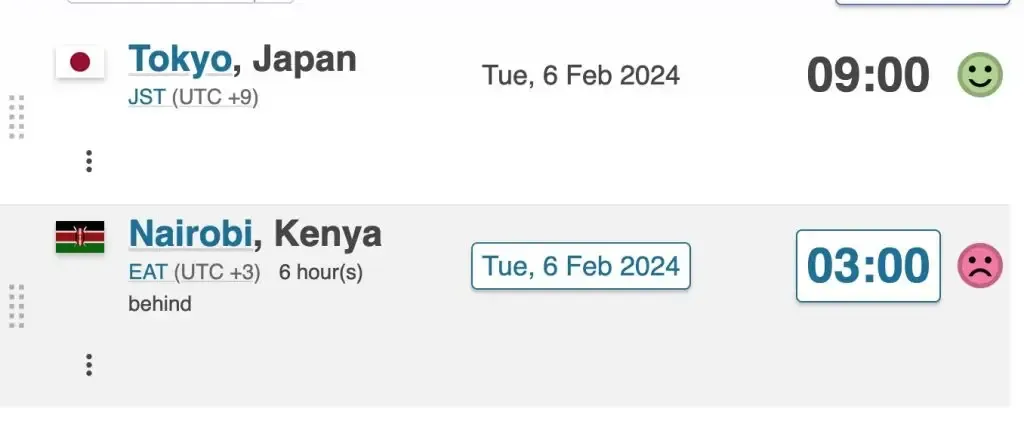
Often referred to as the Asian session, the Tokyo Session is the second major trading session of the day, following the Sydney Session. The session operates from 3 AM to 12 PM East African Time (EAT); a timing that offers unique opportunities and challenges for forex traders in Kenya.
Here’s a breakdown:
- Tokyo Open: 3 AM EAT
- Tokyo Close: 12 PM EAT
Trading during the Tokyo session from Kenya means you’re at the forefront of the day’s market movements.
Click here to learn more about the Asian Session Forex Time in Kenya.
- Market Volatility: The session is generally less volatile compared to the London or New York sessions, making it suitable for traders who prefer stable market conditions.
- Currency Pairs: The Tokyo session sees significant trading in JPY (Japanese Yen) pairs, such as USD/JPY, EUR/JPY, and GBP/JPY. If these pairs are in your trading portfolio, you should pay attention to this session.
- Opportunity to Capitalize on Asian Market Releases: Economic announcements from Japan, Australia, and China during this session can create profitable trading opportunities. Being aware and ready to act on these releases can set the tone for your trading day.
- Strategic Positioning for Later Sessions: By engaging in the Tokyo session, you’re not just taking advantage of immediate opportunities. You’re also setting the stage for potential trades during the London session overlap, preparing strategies based on the trends established in the Asian markets.
For you, the Tokyo session presents a quiet yet promising time to engage in forex trading. Its hours might seem daunting at first glance, but they offer a serene trading environment before the European sessions kick in.
Here’s why these hours are advantageous for you:
- Low Volatility, High Precision: The early part of the Tokyo session often experiences lower volatility compared to the London and New York sessions. This environment allows you to make precise trades, especially if you’re focusing on Asian currencies or looking for less aggressive market movements.
- Opportunity for Night Owls and Early Risers: If you’re a night owl, the start of the Tokyo session aligns perfectly with your late-night activities. Conversely, early risers in Kenya can capitalize on the session’s closing hours, positioning trades based on the Asian market’s day-end trends.
Key Takeaway: While the early hours might seem challenging, the Tokyo session offers a tranquil yet opportunistic time for forex trading. Embrace these hours as a time to explore markets with potentially lower volatility and to prepare for the busier sessions ahead.[forex_sessions_eat]
London Forex Trading Session Time in Kenya
The London Session typically starts at 8:00 AM GMT and ends at 4:00 PM GMT. But you’re in Kenya, right? So, what does this mean for you?
Well, Kenya operates on East Africa Time (EAT), which is 3 hours ahead of GMT. Therefore, in Kenya, the London Session starts at 11:00 AM and ends at 7:00 PM EAT. These hours are incredibly convenient, as they span most of the Kenyan workday, allowing traders to engage with the market without having to alter their daily routines drastically.
Also known as the European trading session, is one of the most active forex trading sessions.
See: London Session Forex Time in Kenya
According to a 2019 report by the Bank for International Settlements, the UK accounted for 43.1% of the global forex market turnover, making the London Session a hotspot for forex trading.
The London forex session is the powerhouse of the forex market, a time when traders around the world are keenly focused on the unfolding market dynamics.
The session is characterized by the rapid movement of currency pairs, especially those involving:
- British Pound (GBP)
- Euro (EUR)
- US Dollar (USD).
Popular technical analysis strategies like the London Breakout Strategy can yield excellent results if utilized properly during this trading period.
Key Takeaway: For Kenyan traders, the London session offers a window into the heart of the forex market’s daily rhythm. It’s a time when your trading skills can truly shine, provided you’re prepared to take advantage of the opportunities it presents.
Related Article: Best Time to Trade EURUSD in Kenya
4. New York Forex Trading Session Time in Kenya

The New York session typically runs from 8:00 AM to 5:00 PM Eastern Standard Time (EST), which translates to 4:00 PM to 1:00 AM in Kenya. This time frame places the bulk of trading activity within a convenient window for Kenyan traders, especially those balancing trading with other commitments.
- According to a study published in the Journal of International Money and Finance, the New York session is one of the most volatile trading periods. This is because it overlaps with the London session, creating a high volume of trades and potentially more opportunities for you to profit.
- The overlap with the London session, which occurs from the start of the New York session until 6:00 PM Kenyan time, is a period of heightened liquidity and volatility. This overlap is a prime time for trading major currency pairs, especially those involving the US dollar (USD), Euro (EUR), and British Pound (GBP).
But remember, with great opportunity comes great responsibility. The increased volatility during the New York session can also mean increased risk.
Additionally, the fast-paced nature of the New York session can be emotionally taxing. Stay calm and objective, avoiding impulsive decisions based on fear or greed.
Employ robust risk management strategies, such as setting stop-loss orders and only trade with money you can afford to lose.
Related Article: New York Session Time in Kenya
The New York session is heavily influenced by a plethora of economic indicators and market drivers, including:
- Non-farm payrolls: This closely watched employment report, released on the first Friday of every month, provides insights into the health of the U.S. labor market and can significantly impact the value of the U.S. dollar.
- Consumer Price Index (CPI): This report measures the changes in the prices of goods and services purchased by consumers, serving as a key indicator of inflation.
- Retail sales: This report gauges consumer spending, a critical component of the U.S. economy.
- Manufacturing and industrial production: These reports shed light on the health of the U.S. manufacturing sector, a major driver of economic growth.
- Federal Reserve (Fed) announcements: The Fed’s monetary policy decisions, particularly interest rate adjustments, can have a profound impact on the forex market.
Key Takeaway: The timing of the New York session offers Kenyan traders a strategic advantage. The late afternoon to midnight window allows individuals to participate in the market after regular work hours, making Forex trading a viable side hustle or a post-work activity.

The 24-Hour Forex Market
Imagine a market that never sleeps, a continuous exchange of currencies happening around the clock—this is the forex market.
Unlike stock markets, which have specific opening and closing times, the forex market operates 24 hours a day during the weekdays.
This round-the-clock action is possible thanks to the global network of banks and financial institutions spread across different time zones.
Why does this matter to you?
Because it means opportunities are always on the horizon, no matter the hour. Whether you’re an early bird catching the first light or a night owl under the moon’s gaze, the forex market has a place for you.
Major Forex Markets: The Four Pillars
The forex market’s heartbeat is regulated by four major trading sessions, each associated with major financial centers across the world:
- Sydney Session: When the Pacific bells ring, the Sydney market opens, marking the start of the forex trading day. It’s the quiet giant, less volatile but equally important.
- Tokyo Session: As the sun rises in Tokyo, Asia gets into full swing. This session is known for its yen movements, a beacon for those interested in Asian currencies.
- London Session: Enter the world’s forex capital. The London session is where the action intensifies, boasting the highest trading volume and offering significant opportunities for traders.
- New York Session: When New York wakes, dollar movements take center stage. This session is crucial for those trading USD pairs, with overlaps with London creating peak trading conditions.
Why The Forex Trading Sessions in Kenyan Time Matter
Each session has its own personality, characterized by specific market behaviors and liquidity patterns. Understanding these can help you align your trading strategy with the most favorable times.
For instance, if you’re aiming for high volatility, the London-New York session overlap might be your golden hour.
On the other hand, if you prefer a more measured approach, the Sydney or Tokyo sessions could offer the stability you seek.
Being aware of these sessions means you can better plan your trading day.
As a Kenyan trader, you have the unique advantage of being geographically placed in a way that allows you to catch the late hours of the Asian markets and the opening of the European and American markets without sacrificing your sleep schedule.
Tools and Resources for Monitoring Forex Sessions in Kenya
Let’s explore some essential tools and resources that will keep you informed and ready to take on the forex market with confidence.
Economic Calendars
An economic calendar is a trader’s best friend. It lists all upcoming economic events, including interest rate decisions, employment reports, and GDP data, with their expected impact on the markets.
Keeping an eye on these events can help you anticipate market movements and adjust your trading strategies accordingly.
- Investing.com Economic Calendar: Offers a comprehensive view of global economic events, customizable to show the data relevant to your trading interests.
- Forex Factory Economic Calendar: Renowned for its user-friendly interface and detailed explanations of how each event may affect different currency pairs
Forex Market Hours Tools
Understanding when different forex markets open and close in Kenyan time is crucial for planning your trading day.
Forex market hours tools allow you to track the opening and closing times of major markets around the globe, helping you pinpoint the best times to trade.
- TradingView: Provides a detailed forex market hours chart that reflects the current status (open or closed) of major markets. It’s integrated with real-time charts and analysis, making it a valuable tool for planning your trades.
- WorldTimeBuddy: A straightforward tool for comparing time zones. It’s especially handy for quickly checking how market hours align with Kenyan time, ensuring you never miss out on prime trading opportunities.
Real-Time News and Analysis
Staying updated with real-time news and analysis is critical for forex trading.
Market sentiments can change rapidly with the release of new economic data or geopolitical events, affecting currency values.
- Bloomberg: Offers up-to-the-minute financial news, market data, and analysis, providing you with insights into how current events are shaping the forex market.
- Reuters: Another excellent source for financial news and global market trends. Its forex news section is particularly useful for understanding currency movements and market drivers.
Forex Trading Platforms with Built-In Tools
Many forex trading platforms offer built-in tools for market analysis, including economic calendars, real-time news feeds, and market hours indicators.
Choosing a platform that provides these tools can streamline your trading process.
- MetaTrader 4/5: Widely used by forex traders, these platforms offer advanced charting tools, automated trading robots (Expert Advisors), and built-in market analysis features.
- cTrader: Known for its user-friendly interface, cTrader offers advanced technical analysis tools, a comprehensive economic calendar, and detailed market hours overview.
Customizable Alerts
Setting up customizable alerts can help you stay informed of market changes without having to constantly monitor the charts.
Most trading platforms and financial news websites allow you to set alerts for specific currency pairs, economic announcements, or price levels.
- TradingView Alerts: You can set up alerts for price levels, technical indicators, or economic events, receiving notifications via email, SMS, or push notifications.
- Forex Alarm: An app specifically designed to send alerts before forex market hours or news releases, ensuring you’re always prepared for volatility spikes.
What is the Best Time to Trade Forex in Kenya?
The London-New York Overlap is the best time to trade forex in Kenya. As a Kenyan trader, these hours can work in your favor in more ways than one. For instance, the overlap of the London and New York sessions (from around 6:00 PM to 10:00 PM Kenyan time) coincides with the evening hours in Kenya. This is a time when you might be winding down from your day’s activities, giving you the perfect opportunity to focus on your trades without distractions.
When Does the London Session Start in Kenya?
The London session starts at 11:00 AM and concludes at 7:00 PM Kenyan time. Kenya is situated in the East Africa Time Zone (EAT), which is 3 hours ahead of Greenwich Mean Time (GMT+3).
The timing of the London session is particularly favorable for you if you’re trading from Kenya.
It starts in the late morning and stretches into the early evening, allowing both early birds and those who prefer to start their day a bit later to find an optimal time to trade.
This schedule accommodates various lifestyles and commitments, whether you’re trading full-time or fitting forex trading around other responsibilities.
When Does Asian Session Start in Kenya?
The Asian session starts at 3:00 AM and extends until 12:00 PM Kenyan time.
The timing of the Asian session is particularly advantageous for early risers or those who prefer trading before embarking on their day’s usual commitments.
It provides a window to engage with markets that are less volatile compared to the New York or London sessions but still offer significant opportunities, especially for currency pairs involving Asian currencies like the Japanese Yen (JPY).
However, the quieter nature of the Asian session can be a double-edged sword; while sudden spikes in volatility are less common, making it a safer playground for beginners or cautious traders, it also requires a keen eye to capture the more subtle movements in currency pairs.
When Does the Forex Market Open in Kenya?
The forex market kicks off for the week with the Sydney session at 1:00 AM Kenyan time (Sunday). This is followed by the Tokyo session starting at 3:00 AM EAT, then the London session at 11:00 AM EAT, and finally, the New York session at 4:00 PM EAT.
The London-New York Overlap is the best time to trade forex in Kenya. As a Kenyan trader, these hours can work in your favor in more ways than one. For instance, the overlap of the London and New York sessions (from around 6:00 PM to 10:00 PM Kenyan time) coincides with the evening hours in Kenya. This is a time when you might be winding down from your day’s activities, giving you the perfect opportunity to focus on your trades without distractions.
The London session starts at 11:00 AM and concludes at 7:00 PM Kenyan time. Kenya is situated in the East Africa Time Zone (EAT), which is 3 hours ahead of Greenwich Mean Time (GMT+3).
The timing of the London session is particularly favorable for you if you’re trading from Kenya.
It starts in the late morning and stretches into the early evening, allowing both early birds and those who prefer to start their day a bit later to find an optimal time to trade.
This schedule accommodates various lifestyles and commitments, whether you’re trading full-time or fitting forex trading around other responsibilities.
The Asian session starts at 3:00 AM and extends until 12:00 PM Kenyan time.
The timing of the Asian session is particularly advantageous for early risers or those who prefer trading before embarking on their day’s usual commitments.
It provides a window to engage with markets that are less volatile compared to the New York or London sessions but still offer significant opportunities, especially for currency pairs involving Asian currencies like the Japanese Yen (JPY).
However, the quieter nature of the Asian session can be a double-edged sword; while sudden spikes in volatility are less common, making it a safer playground for beginners or cautious traders, it also requires a keen eye to capture the more subtle movements in currency pairs.
The forex market kicks off for the week with the Sydney session at 1:00 AM Kenyan time (Sunday). This is followed by the Tokyo session starting at 3:00 AM EAT, then the London session at 11:00 AM EAT, and finally, the New York session at 4:00 PM EAT.