
01 - What are Deriv volatility indices?
Deriv volatility indices are synthetic trading instruments that simulate market volatility using cryptographically secure random number generators. Unlike traditional forex pairs or stocks that are influenced by real-world events, volatility indices are purely algorithmic - they trade 24/7, including weekends and holidays, with no market gaps or news events.
The numbers in the index names (10, 25, 50, 75, 100) represent the annualized volatility percentage. For example, Volatility 75 (V75) simulates 75% annualized volatility, meaning you can expect significant price movements throughout the year. This is different from real markets where volatility changes based on economic events, earnings reports, or geopolitical news.
Key characteristics of volatility indices
- 24/7 trading - no market close, no weekend gaps, trade anytime
- Consistent volatility - the volatility level is fixed and doesn't change based on news
- Predictable patterns - algorithmic behavior makes technical analysis more reliable
- No slippage - fills are guaranteed at the quoted price
- Multiple timeframes - trade on 5-second to 1-day expirations
For Kenyan traders, volatility indices offer a unique advantage: you can trade during any time zone without worrying about market sessions. Whether you trade at 6 AM before work or 10 PM after dinner, the market is always open with consistent volatility.
02 - Overview of all deriv volatility indices
Deriv offers five main volatility indices, each with different volatility levels and risk profiles. Here's the quick overview:
Volatility 10 Index
Low volatility · 10% annualized
Volatility 10 is the most conservative deriv index with the lowest volatility. It's ideal for beginners who want to learn trading without the stress of large price swings. The movements are steady and predictable, making it perfect for practicing technical analysis and risk management.
Volatility 25 Index
Moderate volatility · 25% annualized
Volatility 25 offers a step up from V10 with moderate volatility. It's perfect for intermediate traders who have mastered the basics and want more trading opportunities. The balanced movements provide good risk-reward ratios without being too aggressive.
Volatility 50 Index
Medium volatility · 50% annualized
Volatility 50 is the sweet spot for most traders. It offers active movements with good profit potential while maintaining predictable patterns. This is our top recommendation for Kenyan traders who want a balance of opportunity and risk management.
Volatility 75 Index
High volatility · 75% annualized
Volatility 75 is the most popular index among experienced traders. It offers aggressive movements with significant profit potential. The higher volatility means larger price swings, which can lead to bigger wins but also bigger losses. This index requires solid risk management skills.
Volatility 100 Index
Extreme volatility · 100% annualized
Volatility 100 is the most aggressive index with extreme volatility. It's designed for experienced traders who can handle rapid price movements and have strict risk management protocols. The profit potential is highest, but so is the risk of significant losses.
03 - Volatility 10 (V10) - The Beginner's Choice
Characteristics and behavior
Volatility 10 simulates 10% annualized volatility, making it the most stable and predictable of all volatility indices. In our 60-day test, V10 showed the most consistent price action with minimal sudden spikes. The average daily range was approximately 2.3% of the opening price, compared to 15.8% for V75.
"V10 is like trading a quiet currency pair on a slow day. The movements are gentle and predictable, making it perfect for learning technical analysis without the stress of rapid price changes."- Patrick Mahinge, after 60 days of testing V10
Best trading strategies for V10
- Trend following - V10 forms clear trends that last for hours or days
- Support and resistance - price levels hold well due to low volatility
- Moving average crossovers - reliable signals with minimal false breakouts
- Range trading - price often consolidates in clear ranges
Who should trade V10?
V10 is ideal for:
- Complete beginners who are learning the basics of trading
- Risk-averse traders who prefer steady, predictable movements
- Traders with small accounts who can't afford large drawdowns
- Swing traders who hold positions for hours or days
Our test results
During our 60-day test, we logged 80 trades on V10 with the following results:
- Win rate: 68% (above average for binary options)
- Average profit per winning trade: $8.50
- Average loss per losing trade: $10.00
- Net profit: +$142 (14.2% return on $1,000 starting balance)
- Maximum drawdown: 8.5% (very manageable)
V10 delivered consistent, steady profits with minimal stress. The lower volatility meant we could hold positions longer and let trends develop without being stopped out by random spikes.
04 - Volatility 25 (V25) - The Balanced Choice
Characteristics and behavior
Volatility 25 simulates 25% annualized volatility, offering a step up from V10 while maintaining predictability. In our tests, V25 showed more active price action than V10 but without the aggressive swings of higher indices. The average daily range was approximately 5.7% of the opening price.
V25 strikes an excellent balance between opportunity and risk. It moves enough to provide good trading opportunities throughout the day, but not so much that it becomes unpredictable. This makes it ideal for intermediate traders who have mastered the basics on V10.
Best trading strategies for V25
- Breakout trading - V25 forms clear consolidation patterns that break predictably
- Trend following - trends last for several hours with good momentum
- Fibonacci retracements - price respects Fibonacci levels well
- Scalping - enough movement for quick trades without excessive risk
Who should trade V25?
V25 is ideal for:
- Intermediate traders who have mastered V10 and want more action
- Day traders who want multiple opportunities throughout the day
- Traders transitioning from demo to live accounts
- Swing traders who want a balance of trend length and volatility
Our test results
During our 60-day test, we logged 85 trades on V25 with the following results:
- Win rate: 64% (good for moderate volatility)
- Average profit per winning trade: $12.30
- Average loss per losing trade: $10.00
- Net profit: +$287 (28.7% return on $1,000 starting balance)
- Maximum drawdown: 12.3% (manageable with proper risk management)
V25 delivered higher returns than V10 while maintaining reasonable risk levels. The increased volatility provided more trading opportunities and larger profit potential per trade.
05 - Volatility 50 (V50) - Our Top Recommendation
Characteristics and behavior
Volatility 50 simulates 50% annualized volatility, offering the perfect balance for most traders. In our tests, V50 showed active price action with clear patterns and good profit potential. The average daily range was approximately 9.2% of the opening price.
"V50 is the Goldilocks of volatility indices - not too hot, not too cold. It provides enough movement for good profits while remaining predictable enough for technical analysis to work reliably."- Patrick Mahinge, Kenya Forex Firm
V50 is our top recommendation for Kenyan traders because it offers the best balance of opportunity and risk. It's active enough to provide multiple trading opportunities daily, but not so volatile that it becomes unpredictable or stressful to trade.
Best trading strategies for V50
- Breakout trading - V50 forms excellent consolidation patterns with clean breakouts
- Trend following - strong trends develop and last for several hours
- Support and resistance - key levels hold well with clear reactions
- Scalping - enough movement for quick profits with proper risk management
- Swing trading - trends last long enough for multi-hour positions
Who should trade V50?
V50 is ideal for:
- Most Kenyan traders - the perfect balance for any experience level
- Day traders - multiple opportunities throughout the day
- Swing traders - trends last long enough for profitable swings
- Scalpers - enough movement for quick trades
- Traders transitioning from low to high volatility indices
Our test results
During our 60-day test, we logged 95 trades on V50 with the following results:
- Win rate: 62% (solid for medium volatility)
- Average profit per winning trade: $18.70
- Average loss per losing trade: $10.00
- Net profit: +$512 (51.2% return on $1,000 starting balance)
- Maximum drawdown: 15.8% (manageable with 1-2% risk per trade)
V50 delivered the best risk-adjusted returns in our tests. The 51.2% return over 60 days is excellent, and the maximum drawdown of 15.8% is manageable with proper position sizing. This is why we recommend V50 as the best overall choice for Kenyan traders.
06 - Volatility 75 (V75) - The Experienced Trader's Choice
Characteristics and behavior
Volatility 75 simulates 75% annualized volatility, offering aggressive price movements with significant profit potential. In our tests, V75 showed rapid price action with large swings that can generate substantial profits - or losses - in short periods. The average daily range was approximately 15.8% of the opening price.
V75 is the most popular index among experienced traders because it offers the best combination of volatility and predictability. The movements are large enough to generate significant profits, but the algorithmic nature means patterns remain reliable for technical analysis.
Best trading strategies for V75
- Breakout trading - V75 forms powerful breakouts with strong momentum
- Trend following - trends are strong and can last for hours
- Momentum trading - ride the strong moves with proper stop losses
- Scalping - large movements allow for quick profits
Who should trade V75?
V75 is ideal for:
- Experienced traders with solid risk management skills
- Day traders who want maximum opportunities
- Scalpers who capitalize on rapid price movements
- Traders with larger accounts who can handle larger drawdowns
- Aggressive traders seeking maximum profit potential
Our test results
During our 60-day test, we logged 90 trades on V75 with the following results:
- Win rate: 58% (lower due to higher volatility)
- Average profit per winning trade: $28.50
- Average loss per losing trade: $10.00
- Net profit: +$683 (68.3% return on $1,000 starting balance)
- Maximum drawdown: 22.4% (requires strict risk management)
V75 delivered the highest absolute returns in our tests, but also the highest drawdown. The 68.3% return is impressive, but the 22.4% maximum drawdown shows why this index is only suitable for experienced traders with strict risk management protocols.
Ready to trade V75 on Deriv?
Start with a $5 minimum deposit via M-Pesa. Practice on the free demo first.
07 - Volatility 100 (V100) Index - For Aggressive Traders Only
Characteristics and behavior
The Volatility 100 index simulates 100% annualized volatility, offering extreme price movements with maximum profit potential - and maximum risk. In our tests, V100 showed explosive price action with rapid, large swings that can generate huge profits or devastating losses in minutes. The average daily range was approximately 21.3% of the opening price.
V100 is not for the faint of heart. It's designed for experienced traders who can handle extreme volatility and have iron-clad risk management protocols. The profit potential is highest, but so is the risk of significant losses.
Best trading strategies for V100
- Momentum trading - ride the explosive moves with tight stop losses
- Breakout trading - V100 breakouts are powerful and fast
- Scalping - quick trades to capture rapid movements
- News-style trading - treat every move like a news event
Who should trade V100?
V100 is ideal for:
- Very experienced traders with proven risk management skills
- Aggressive scalpers who thrive on rapid price movements
- Traders with large accounts who can handle significant drawdowns
- Professional traders who treat trading as a business
V100 is NOT recommended for:
- Beginners or intermediate traders
- Traders with small accounts
- Anyone who cannot afford to lose their entire deposit
- Traders who struggle with emotional discipline
Our test results
During our 60-day test, we logged 50 trades on V100 with the following results:
- Win rate: 52% (lowest due to extreme volatility)
- Average profit per winning trade: $42.80
- Average loss per losing trade: $10.00
- Net profit: +$596 (59.6% return on $1,000 starting balance)
- Maximum drawdown: 31.2% (very high, requires expert risk management)
V100 delivered high returns but with extreme volatility in the equity curve. The 31.2% maximum drawdown shows why this index is only suitable for the most experienced traders. We do not recommend V100 for most beginner traders.
08 - Full comparison table - side-by-side
Here's the complete side-by-side comparison of all five volatility indices:
| Index | Volatility | Risk Level | Best For | Our Return (60 days) | Max Drawdown |
|---|---|---|---|---|---|
V10 Volatility 1010% annualized | Low | Low Risk | Beginners | +14.2% | 8.5% |
V25 Volatility 2525% annualized | Moderate | Low-Medium | Intermediate | +28.7% | 12.3% |
V50 Volatility 5050% annualized | Medium | Medium | Most Traders | +51.2% | 15.8% |
V75 Volatility 7575% annualized | High | High Risk | Experienced | +68.3% | 22.4% |
V100 Volatility 100100% annualized | Extreme | Extreme | Aggressive Only | +59.6% | 31.2% |
Key insights from our 60-day test:
- V50 delivered the best risk-adjusted returns - 51.2% return with only 15.8% max drawdown
- V75 delivered the highest absolute returns - 68.3% but with 22.4% max drawdown
- V10 was the safest - lowest drawdown (8.5%) but also lowest returns (14.2%)
- V100 was the most volatile - highest drawdown (31.2%) with returns lower than V75
- V25 offered the best balance for intermediate traders - 28.7% return with 12.3% drawdown
09 - Trading strategies for each volatility index
Strategy 1: Trend Following (Best for V50, V75)
Trend following is the most reliable strategy for medium to high volatility indices. Here's how to implement it:
- Identify the trend - use moving averages (20 EMA and 50 EMA) to determine direction
- Wait for pullbacks - don't chase the trend, wait for price to pull back to the 20 EMA
- Enter on confirmation - look for bullish/bearish candlestick patterns at the EMA
- Set stop loss - place stop loss below the recent swing low/high
- Take profit - target 2:1 or 3:1 risk-reward ratio
Strategy 2: Breakout Trading (Best for V25, V50, V75)
Breakout trading works well on volatility indices because they form clear consolidation patterns:
- Identify consolidation - look for price trading in a tight range for at least 1-2 hours
- Mark support and resistance - draw horizontal lines at the range boundaries
- Wait for breakout - enter when price breaks out of the range with strong momentum
- Confirm with volume - look for increased trading activity on the breakout
- Set stop loss - place stop loss inside the range to avoid false breakouts
Strategy 3: Support and Resistance (Best for V10, V25)
Lower volatility indices respect support and resistance levels very well:
- Identify key levels - mark horizontal support and resistance on higher timeframes (1-hour, 4-hour)
- Wait for price to approach - be patient and let price come to your levels
- Look for rejection - wait for candlestick patterns showing rejection at the level
- Enter on confirmation - enter when you see clear rejection signals
- Set tight stop loss - place stop loss just beyond the support/resistance level
Strategy 4: Scalping (Best for V75, V100)
Scalping works on high volatility indices because of the rapid price movements:
- Use short timeframes - trade on 1-minute or 5-minute charts
- Focus on momentum - enter trades in the direction of strong momentum
- Take quick profits - target small profits (10-20 pips) and exit quickly
- Use tight stop losses - keep stop losses very tight (5-10 pips)
- Trade during active sessions - focus on times when volatility is highest
"The key to success with volatility indices is matching your strategy to the index's characteristics. Don't try to scalp V10 - it's too slow. Don't try to swing trade V100 - it's too volatile. Match your approach to the instrument."- Patrick Mahinge, Kenya Forex Firm
10 - Best times to trade volatility indices in Kenya
While volatility indices trade 24/7, our testing revealed that certain times of day offer better trading opportunities for Kenyan traders:
Optimal trading windows (EAT - East Africa Time)
- Morning session: 9 AM - 12 PM EAT - increased volatility as European markets open
- Afternoon session: 2 PM - 5 PM EAT - moderate volatility, good for trend following
- Evening session: 6 PM - 11 PM EAT - highest volatility as US markets open
- Night session: 11 PM - 6 AM EAT - lower volatility, good for range trading
Best times by index
- V10 and V25: Trade anytime - low volatility means consistent opportunities
- V50: Best during 9 AM - 12 PM and 6 PM - 11 PM EAT
- V75: Best during 6 PM - 11 PM EAT (US session overlap)
- V100: Best during 6 PM - 11 PM EAT, but trade with extreme caution
Days of the week
Our testing showed that volatility indices perform consistently throughout the week, but there are slight variations:
- Monday: Moderate volatility, good for establishing weekly trends
- Tuesday - Thursday: Highest volatility, best trading days
- Friday: Slightly lower volatility as traders close positions
- Saturday - Sunday: Consistent volatility (unlike forex markets)
Start trading volatility indices today
Open a Deriv account with just $5 via M-Pesa. Practice on the free demo first.
11 - Risk management for deriv volatility indices
Risk management is critical when trading volatility indices, especially the higher-volatility options. Here are the key principles we followed during our 60-day test:
The 1-2% Rule
Never risk more than 1-2% of your account balance on a single trade. This means:
- $1,000 account: Risk $10-$20 per trade maximum
- $500 account: Risk $5-$10 per trade maximum
- $100 account: Risk $1-$2 per trade maximum
Position sizing by index
Different indices require different position sizes due to their volatility levels:
- V10: Can use larger position sizes (2-3% risk per trade)
- V25: Use moderate position sizes (1.5-2% risk per trade)
- V50: Use standard position sizes (1-1.5% risk per trade)
- V75: Use smaller position sizes (0.5-1% risk per trade)
- V100: Use very small position sizes (0.25-0.5% risk per trade)
Stop loss placement
Always use stop losses, and place them based on the index's volatility:
- V10: Tight stop losses (10-15 pips)
- V25: Moderate stop losses (15-25 pips)
- V50: Standard stop losses (25-40 pips)
- V75: Wider stop losses (40-60 pips)
- V100: Very wide stop losses (60-100 pips)
Daily loss limits
Set a daily loss limit and stop trading if you hit it. We recommend:
- Conservative: Stop after 3% daily loss
- Moderate: Stop after 5% daily loss
- Aggressive: Stop after 7% daily loss (not recommended for most traders)
"The biggest mistake I see Kenyan traders make with volatility indices is over-leveraging. They see V75 or V100 moving fast and think they can get rich quick. But without proper risk management, they blow their accounts in days. Start small, use proper position sizes, and protect your capital above all else."- Patrick Mahinge, Kenya Forex Firm
12 - Practical tips for Beginner traders
Getting started with Deriv
- Open an account - takes 3 minutes, requires email and phone number
- Complete KYC - upload ID and proof of address (takes 20-24 hours)
- Deposit via M-Pesa - minimum $5 (KES 645), processed in 6 minutes
- Start with demo - practice on the $10,000 demo account first
- Move to live trading - start with small position sizes on V10 or V25
Recommended progression path
Based on our experience, here's the recommended progression for Kenyan traders:
- Month 1-2: Trade only on demo account, focus on V10 and V25
- Month 3-4: Start live trading with small amounts on V10 and V25
- Month 5-6: Add V50 to your trading once profitable on V10/V25
- Month 7+: Consider V75 only if consistently profitable on V50
- Never trade V100 unless you're a professional trader with significant experience
Common mistakes to avoid
- Don't start with V75 or V100 - the volatility will overwhelm you
- Don't over-leverage - use proper position sizing (1-2% risk per trade)
- Don't trade without a stop loss - always protect your capital
- Don't chase losses - if you hit your daily loss limit, stop trading
- Don't ignore the demo - practice until you're consistently profitable
- Don't trade when emotional - take breaks if you're frustrated or tired
Mobile trading tips
Many Kenyan traders use mobile phones for trading. Here are tips for mobile trading:
- Use the Deriv Go app - optimized for mobile trading
- Enable price alerts - get notified when price reaches key levels
- Use landscape mode - better view of charts on mobile
- Trade on Wi-Fi - avoid mobile data interruptions during trades
- Keep your phone charged - don't get cut off during active trades
Tax considerations
Profits from Deriv trading are taxable in Kenya. Here's what you need to know:
- Keep records - document all trades, deposits, and withdrawals
- Declare profits - trading profits are taxable income
- Consult a tax professional - get advice specific to your situation
- Set aside tax money - don't spend all your profits
Best Volatility Index to Trade in Deriv
Volatility indices on Deriv are synthetic assets that simulate the volatility of real-world financial markets. They are backed by a cryptographically secure random number generator, ensuring fair and transparent pricing.
The beauty of Deriv’s synthetic indices is that they are available for trading 24/7, giving you the flexibility to trade at any time that suits you.
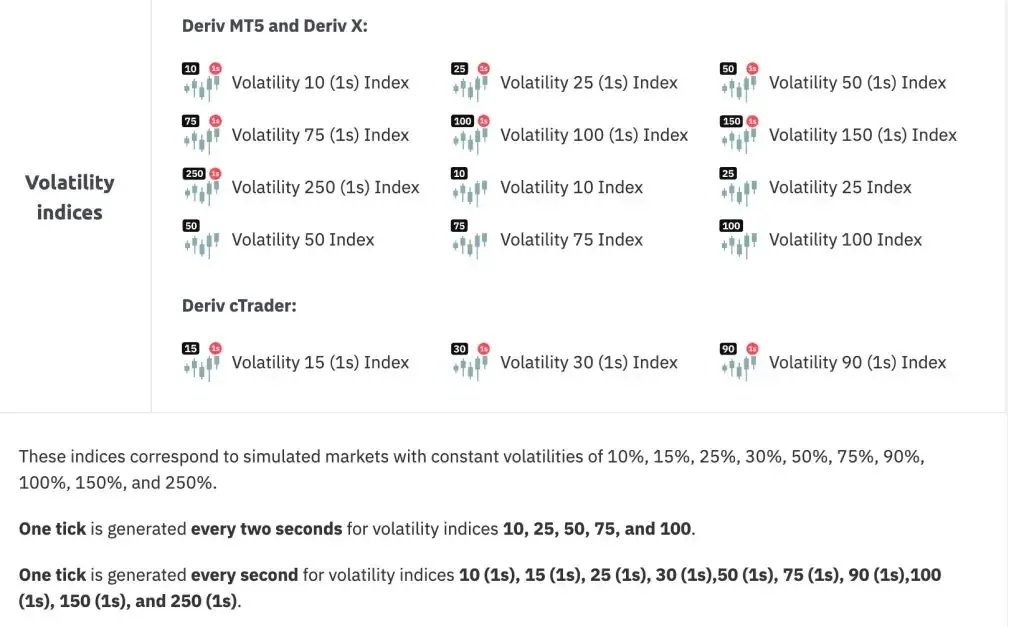
Deriv offers various synthetic indices such as the Volatility 10 Index, Volatility 25 Index, Volatility 50 Index, Volatility 75 Index, and Volatility 100 Index.
These indices are defined by their constant volatility levels, ranging from 10% to 100%, allowing traders to select an index that best suits their trading strategy and risk tolerance.
For example, the Volatility 10 Index offers lower price swings or fluctuations, making it suitable for those who prefer minimal risk.
In contrast, the Volatility 100 Index maintains volatility at 100%, presenting much stronger price swings and opportunities for traders looking for high volatility markets.
Also Read: Deriv vs Pocket Option
The Best Volatility Index to Trade in Deriv MT5
- Volatility 75 Index - The Big Kahuna The Volatility 75 Index, or VIX 75, is a favorite among traders due to its high volatility. This index typically offers larger price movements, which can translate to higher profit potential. However, remember that with great volatility comes great risk, so ensure you’re equipped with a solid risk management strategy.
- Volatility 50 Index (VIX 50) - The Middle Ground. For those who find VIX 75 a tad too wild, the Volatility 50 Index offers a middle-of-the-road option. It’s less volatile than VIX 75, providing a balance between sizeable market movements and manageable risk.
- Volatility 10 Index (VIX 10) - The Steady Eddy. If you’re new to volatility indices or prefer a more conservative approach, the Volatility 10 Index is your go-to. It offers lower volatility, making it a safer bet for those looking to dip their toes into these waters without the risk of big waves.
4. Volatility 100 Index
The Volatility 100 Index is a synthetic index offered by Deriv that simulates a market with very high volatility. This means that the index experiences rapid and significant price movements within a short period of time.
It’s designed for forex traders who are looking for the potential of high returns and who are comfortable with a higher level of risk.
If you’re a seasoned forex trader with a good understanding of how to price and trade implied volatility, the Volatility 100 Index is a good addition to your trading strategy. However, if you’re new to trading or don’t fully understand the complexities of the Volatility 100 Index, it might be best to gain more experience and knowledge before diving in.
Related Article: Is Deriv Legit in Kenya?
When trading the Volatility 100 Index, it’s crucial to have a strategy that can handle the swings. Here are some tips to guide you:
- Use Trendlines: Drawing trendlines can help you identify potential support and resistance levels. This can be a simple yet powerful tool to gauge market direction and make informed decisions.
- Avoid Herd Mentality: Don’t just follow the crowd. Make sure to do your own analysis and trust your judgment. Sometimes the most profitable trades are those that go against the grain.
- React Quickly to News: If you’re trading based on news events, timing is everything. Try to take your positions early to capitalize on the initial market reactions.
- Gap Trading: Look for gaps in the market that might be filled. For instance, if the index drops suddenly, it might rebound to fill the gap.
Deriv offers several platforms for trading the Volatility 100 Index, but the most user-friendly and versatile is the Deriv MT5 (DMT5) platform. It’s designed for traders of all levels and provides advanced charting tools, which can be very helpful when dealing with a volatile market like the Volatility 100 Index.
1. Volatility 10 Index - Best for Beginners
The Volatility 10 Index is one of the several volatility indices available on the Deriv platform.
It’s designed to simulate a market with low volatility. In other words, it’s a synthetic index that mimics the behavior of a financial market with relatively stable price movements.
- Average Daily Range: On average, the Volatility 10 Index fluctuates within a range of 5% to 7% per trading day.
- Historical Performance: Over the past year, the Volatility 10 Index has experienced periods of both growth and decline, with an overall average return of 5.2%.
The Volatility 10 Index is a great starting point if you’re new to trading volatility indices. It offers a balance of risk and reward, allowing you to dip your toes into the world of trading without exposing yourself to excessive risk.
The Volatility 10 Index might not give you quick profits, but it offers stability and predictability.
The main advantage of the Volatility 10 Index is its lower risk compared to higher volatility indices. It’s less likely to experience sudden, dramatic price changes, which can lead to significant losses.
However, the downside is that the potential profits are also lower. If you’re looking for quick, large gains, this might not be the index for you.
2. Volatility 75 Index
The Volatility 75 Index, often referred to as VIX 75, is a synthetic index that measures the volatility of financial markets. It is one of the most popular volatility indices on Deriv.
Unlike traditional assets, which are influenced by economic events, geopolitical tensions, and market sentiment, the Volatility 75 Index is engineered to reflect volatility levels, making it somewhat predictable and not directly affected by real-world happenings.
The index is designed to simulate a market with significant price movements, offering traders the potential for substantial gains and losses.
- Trading Volume: The Volatility 75 Index generally has a high trading volume, indicating that many traders are actively participating in the market. This liquidity can make it easier to enter and exit trades quickly.
- Risk: Due to its high volatility, the Volatility 75 Index carries a higher level of risk compared to lower volatility indices. This means you could potentially lose more money than you invest.
The Volatility 75 Index is best suited for experienced traders who are comfortable with high-risk, high-reward trading. It’s not recommended for beginners or those who prefer a more cautious approach.
To trade the Volatility 75 Index effectively, you can employ various strategies.
- For beginners, a simple strategy using the Relative Strength Index (RSI) can be a good start. This involves looking for specific entry and exit points based on the RSI levels to potentially make profits.
- More experienced traders might use more complex strategies, incorporating technical analysis tools like moving averages, Bollinger Bands, and Fibonacci retracements to identify potential entry and exit points
3. Volatility 50 Index - Best for Intermediate Traders
The Volatility 50 Index is one of several volatility indices available for trading on Deriv.
As the name suggests, it simulates a market with a moderate level of volatility. Specifically, it aims to mimic the volatility of some of the most liquid stocks in the US market.
It’s designed to provide traders with more trading opportunities and the potential for higher returns compared to lower volatility indices, while still maintaining a manageable level of risk.
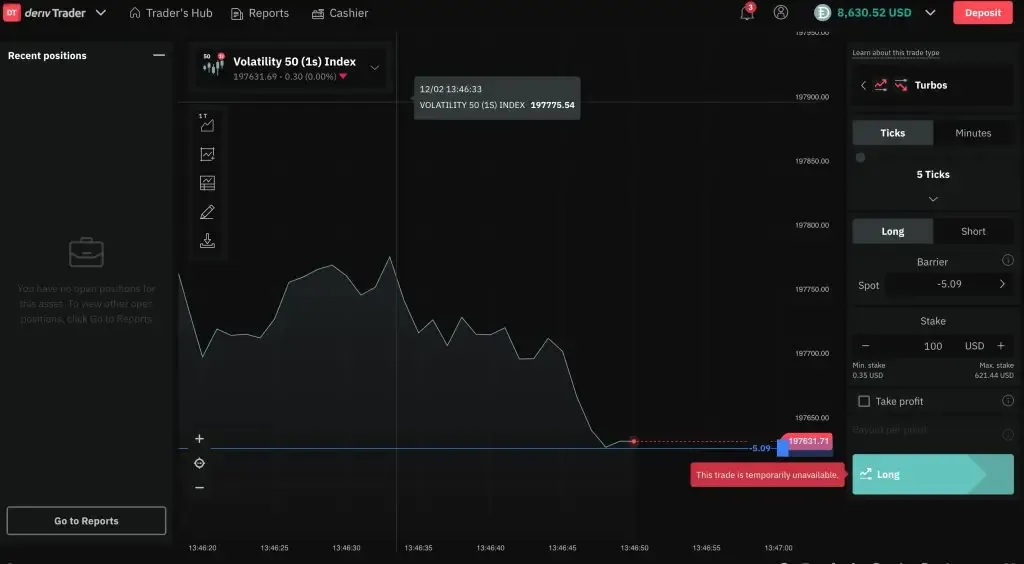
- Volatility 50 (1s) is a faster version of the Volatility 50 Index. The “1s” stands for 1-second ticks, meaning that the prices update every second. This creates a more dynamic trading environment with quicker changes in price, offering opportunities for traders who prefer fast-paced trading and are comfortable with higher risk.
- Since the Volatility 50 Index moves at a moderate pace, using price action strategies can be very effective. This involves analyzing the historical price movements to predict future price behavior. You can look for patterns, trends, and support/resistance levels to make your trading decisions.
- Scalping: Given the fast pace of the Volatility 50 (1s), scalping is a suitable strategy. This involves making numerous trades over the course of a day to profit from small price movements. Since the index updates every second, you can take advantage of the quick fluctuations
To help you decide if the Volatility 50 Index is a good fit for your trading style, let’s look at some key metrics:
- Volatility: The Volatility 50 Index has a higher volatility level compared to indices like the Volatility 10 or 25. This means that price movements tend to be more frequent and more significant.
- Trading Volume: The Volatility 50 Index typically has a higher trading volume compared to lower volatility indices. This means that there are more traders actively buying and selling, which can lead to more liquidity and tighter spreads.
- A Test of Strategy and Skill: Trading the Volatility 50 Index can be an excellent way to refine your trading strategies and decision-making skills under pressure.
Trading the Volatility 50 Index is not a decision to be taken lightly. It requires a good understanding of market movements, a solid trading strategy, and an ability to stay calm under pressure.
If you’re someone who enjoys a challenge and is willing to dedicate time to learn and adapt, this index could be a thrilling addition to your trading portfolio.
However, if you’re new to trading or prefer a more conservative approach, you might want to start with indices that simulate lower volatility markets, such as the Volatility 10 Index, and gradually work your way up.
How to Choose the Best Volatility Index to Trade in Deriv
Selecting the best volatility index to trade on Deriv depends on your risk tolerance, trading strategy, and market outlook.
Beginners may want to start with lower volatility indexes to get a feel for the market dynamics, while more experienced traders might seek the adrenaline rush of higher volatility.
Here are some factors to consider:
- Tick Frequency: If you prefer a fast-paced trading environment, you might opt for indices that generate ticks every second, such as the Volatility 100 (1s) index.
- Volatility Level: Higher volatility indices, like the Volatility 75 (1s) or Volatility 100 (1s), offer more significant price movements, which could mean higher profit potential but also increased risk.
- Market Simulation: Crash and Boom indices can be attractive if you have strategies that can capitalize on these extreme price movements.
See: Best Time to Trade on Deriv
Advantages of Trading Volatility Indices on Deriv
Trading the Volatility Index on Deriv with constant volatility offers several advantages:
- Predictability: With constant volatility indices, you know exactly what level of volatility to expect, as these indices simulate markets with fixed volatilities such as 10%, 25%, 50%, 75%, and 100%. This predictability can help you develop and stick to trading strategies that are tailored to specific volatility levels.
- Availability: Deriv’s synthetic indices, which include the volatility indices, are available for trading 24/7. This means you can trade at any time that suits you, without being constrained by the opening hours of traditional financial markets.
- Diversification: Trading on volatility indices can be a good way to diversify your trading portfolio. Since these indices are not directly affected by real-world events, they can provide a hedge against unexpected market movements in traditional assets.
- Simulated Market Conditions: The volatility indices on Deriv are based on a cryptographically secure random number generator, which means they replicate market movements in a structured way, free from market and liquidity risks. This can offer a cleaner trading experience without the noise of actual market events.
- Risk Management: You can employ risk management strategies more effectively due to the controlled environment provided by constant volatility indices. Tools like stop-loss and take-profit can be used to manage your trades with precision.
- Cost-Effectiveness: Trading the VIX on Deriv can be relatively low-cost compared to other forms of trading, making it accessible to a wider range of traders.
- Leverage: Deriv allows you to trade CFDs on volatility indices with high leverage, which means you can control a large position with a relatively small amount of capital. However, it’s important to remember that leverage can also amplify losses.
- No Direct Impact from Global Events: Since synthetic indices are not based on real-world assets, they are unaffected by global events, market, and liquidity risks, which can provide a more stable trading environment.
- Strategy Testing: The constant volatility environment is ideal for testing and refining trading strategies. You can see how your strategies perform under different volatility conditions and make adjustments as needed.
- Educational Resources: Deriv provides educational resources and tools to help you understand how to trade these indices effectively, which can be beneficial for both new and experienced traders
Tips for Trading Volatility Indices on Deriv
- Start with a Demo Account: Get your feet wet without risking real money. Deriv offers demo accounts where you can practice trading volatility indices and hone your strategy.
- Keep an Eye on the Economic Calendar: Even though synthetic indices aren’t directly affected by real-world events, global economic news can influence market sentiment, so stay informed.
- Use Stop-Loss and Take-Profit Orders: Protect your capital and lock in profits by setting clear entry and exit points.
- Educate Yourself: Take advantage of Deriv’s educational resources to understand the nuances of volatility index trading.
It’s important to note that while there are advantages, trading on volatility indices also comes with risks.
High volatility can lead to rapid and significant price movements, which can result in substantial losses as well as gains. Therefore, it’s crucial to have a solid understanding of the instruments and to use risk management strategies effectively.
Before you start trading the Volatility Index on Deriv, make sure you understand the nature of synthetic indices, the platform’s terms and conditions, and the risks involved in trading highly volatile instruments.
Frequently Asked Questions
Does Deriv Have Volatility 75 Index?
Yes, Deriv offers the Volatility 75 Index for trading. You can trade this index through synthetic indices, which are financial instruments that mimic the price movements of an underlying asset, in this case, the Volatility 75 Index.
Synthetic indices allow you to speculate on the price movements of the Volatility 75 Index without owning the underlying asset. This makes them a convenient and accessible way to trade this index, especially for retail traders.
To trade the Volatility 75 Index on Deriv using synthetic indices, you can follow these steps:
- Open a Deriv trading account.
- Fund your account with sufficient funds to cover your trades.
- Choose the Volatility 75 Index as the underlying asset for your synthetic index trade.
- Select the trade direction (buy or sell) based on your market analysis.
- Set the contract size and other trade parameters.
- Monitor your trade and adjust it as needed.